
Which of E.B. White’s "Three New Yorks" Do You Belong To?
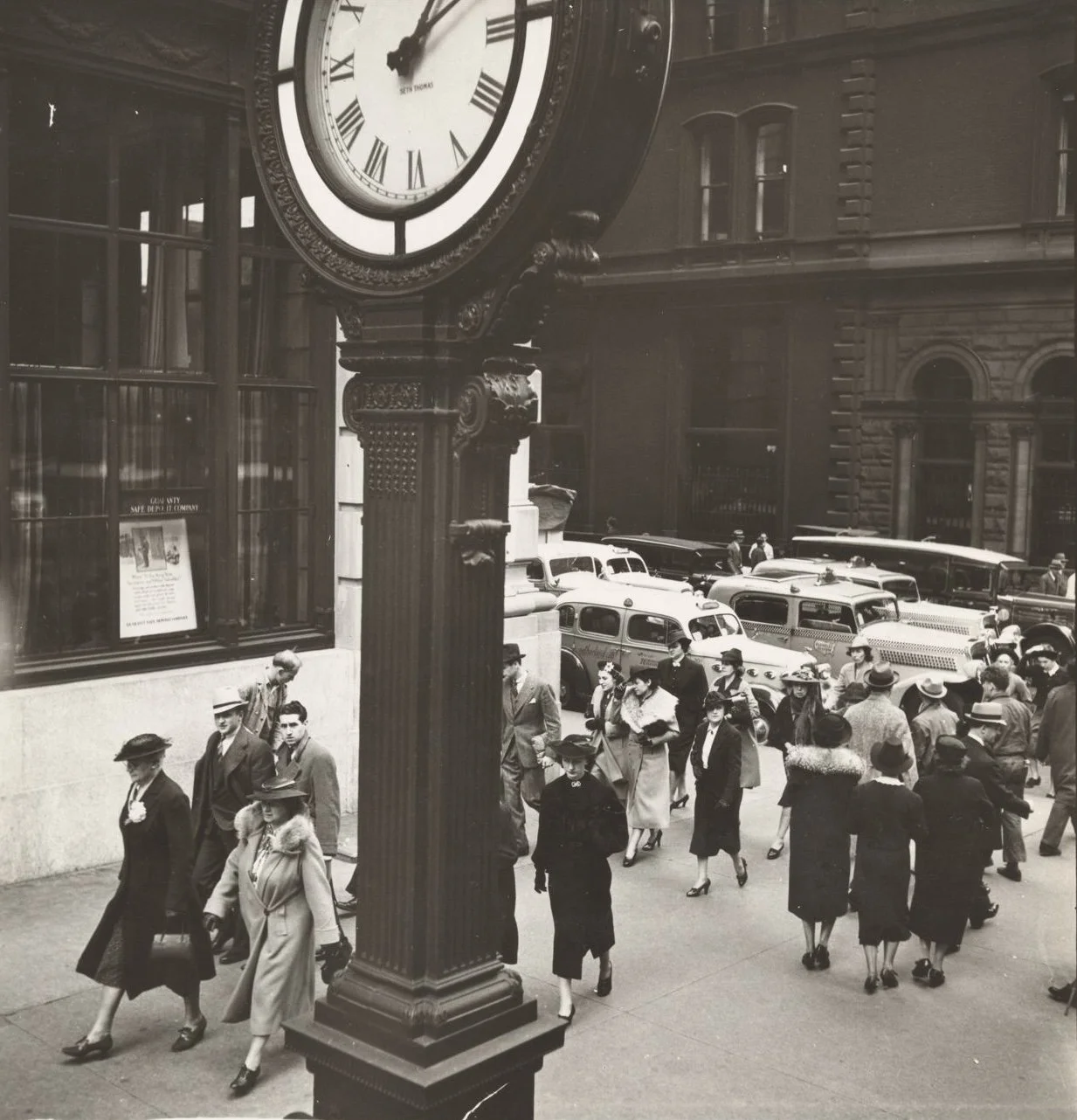
"Tempo of the City: I, Fifth Avenue and 44th Street,” 1938, Photographer Berenice Abbott, (1898-1991), New York Public Library Digital Collections., The Miriam and Ira D. Wallach Division of Art, Prints and Photographs: Photography Collection, The New York Public Library.
Our Book Policy: We default to Bookshop.org to support local stores, using Amazon only as a backup. As a Bookshop affiliate and Amazon Associate, we earn from qualifying purchases at no extra cost to you.
𐫱
New York City has over eight million residents, but according to the legendary author E.B. White, there are only ever three people walking its streets.
In the hot summer of 1948, sitting in a sweltering room at the Algonquin Hotel, White penned Here is New York. Published as an essay in 1949, it remains the definitive piece of urban prose. While the city's skyline changes by the minute, White's psychological dissection of the people who live here remains entirely untouched by time.
White famously wrote that to understand the chaotic harmony of Manhattan, you must first understand its three distinct human components:
"There are roughly three New Yorks. There is, first, the New York of the man or woman who was born here, who takes the city for granted and accepts its size and its turbulence as natural and inevitable. Second, there is the New York of the commuter — the city that is devoured by such as can spin hidden in the mists of the morning and evening, smuggler-fashion, across the borders. And third, there is the New York of the person who was born elsewhere and came to New York in quest of something."
Depending on which door you used to enter the city, your relationship with New York will look completely different. Let’s break down White’s three "tribes"—and look at what they look like in the modern day.
1. The Native: The Anchor of Continuity
While the transplants and tourists treat Manhattan like a giant stage, there is an entire population that simply views it as their backyard. To understand this first group, you have to look at how E.B. White defined them:
"There is, first, the New York of the man or woman who was born here, who takes the city for granted and accepts its size and its turbulence as natural and inevitable. Commuters give the city its tidal restlessness; natives give it solidity and continuity..."
For the native, New York isn't an achievement or a dream destination—it is an inevitability. They do not look at the skyscrapers with awe; they look at them as the background noise of their daily commute. Because they have seen the city through every cycle of economic boom, crisis, and cultural shift, they provide the necessary friction that keeps New York from completely losing its identity.
Today, this is the person who still lives blocks away from their childhood apartment in Queens, Brooklyn, or the Bronx. They don't care about the trendy, overpriced cocktail lounges opening up down the street. Instead, they are the fierce protectors of the neighborhood's soul.
They are the ones keeping the 40-year-old family bakery alive, the ones who remember the name of the bodega owner from twenty years ago, and the ones who can tell you exactly what a block looked like before the luxury glass high-rises went up. Without them, New York would turn into a sterile amusement park. They are the human bedrock of the city.
2. The Commuter: The Restless Tide
If the natives give the city its roots, the second group provides its kinetic, chaotic heartbeat. Every morning, millions of people flood across the city's borders, only to vanish the second the sun goes down. E.B. White captured this strange, transactional relationship perfectly:
"Second, there is the New York of the commuter — the city that is devoured by such as can spin hidden in the mists of the morning and evening, smuggler-fashion, across the borders... Commuters give the city its tidal restlessness..."
To White, the commuter is a regular invader. They extract wealth, energy, and opportunity from the pavement of Manhattan, but they refuse to give the city their nights, their taxes, or their hearts. They do not live in New York; they simply use it as an economic engine before escaping back to the quiet of the suburbs.
Today, you can witness this tidal wave at 8:30 AM and 5:30 PM inside Grand Central Terminal, Penn Station, or the PATH gates. This tribe consists of the suburbanites from Long Island, New Jersey, Westchester, and Connecticut.
Their version of New York is highly optimized, sterile, and entirely functional. It is defined by a strict geographical grid: the train platform, the specific coffee shop on the walk to the office, the midtown salad spot, and the closest corporate happy hour bar. They experience the city through its stress and its hustle, but they miss its magic. The moment they step back onto the commuter rail at twilight, their version of New York ceases to exist.
3. The Settler: The Engine of Passion
The final New York belongs to the dreamers, the outcasts, and the ambitious. This group didn’t inherit the city, and they don't just use it for a paycheck—they actively chose it, often at a massive personal cost. E.B. White considered this tribe the absolute lifeblood of Manhattan:
"And third, there is the New York of the person who was born elsewhere and came to New York in quest of something... but the settlers give it passion. Of the three, the third New York is the greatest — the New York of the man who was born elsewhere and came to New York in quest of something. It is this third city that accounts for New York's high-strung quality, its achievement in poetry and in commerce, and its importunate growth."
To White, the "settler" is the true inventor of New York. Because they migrated here in pursuit of a goal—whether that goal was artistic fame, corporate dominance, or simply the freedom to be who they truly are—they look at the city with an intensity that the other two tribes can rarely match. They are the ones who inject the city with its famous, electric, high-strung energy.
Today, this is the transplant who arrived at JFK or LaGuardia with two suitcases, a severe lack of savings, and a blind determination to make it work. They are the ones enduring the grueling apartment hunts, living with three random roommates in Bushwick or Astoria, and spending half their income just to survive.
The settler doesn't take New York for granted because they have to fight to earn their place here every single day. They are the artists, the late-night bartenders, the tech founders, and the young professionals who stay out until 3:00 AM because they are utterly infatuated with the city's velocity. They are the reasons why New York remains a cultural capital; they keep the dream of the city alive.
The Shared Madness of Manhattan
Ultimately, none of these three tribes can exist without the others. If New York were made entirely of commuters, it would be a cold, empty corporate ghost town by 6:00 PM. If it were populated only by settlers, the city would burn out from its own hyper-ambitious, high-strung exhaustion. And without the natives, the city would lose its historical grounding entirely, drifting away into a generic, gentrified amusement park.
It is the constant, daily friction between the anchor of the native, the restlessness of the commuter, and the burning passion of the settler that creates the irreplaceable magic of New York City. Decades after E.B. White shut his door at the Algonquin Hotel, his three-part blueprint still perfectly explains the beautiful chaos outside your window.
So, which tribe do you belong to? Drop a comment!