The History of Tulips in Art
The tulip blooms for less than a couple of weeks each year. Yet, it remains one of the most frequently depicted flowers in art.
From decorative motifs to botanical studies to the arranged compositions of the 17th century and beyond, artists have returned to it repeatedly—each time giving it a new role.
The works that follow trace that evolution.
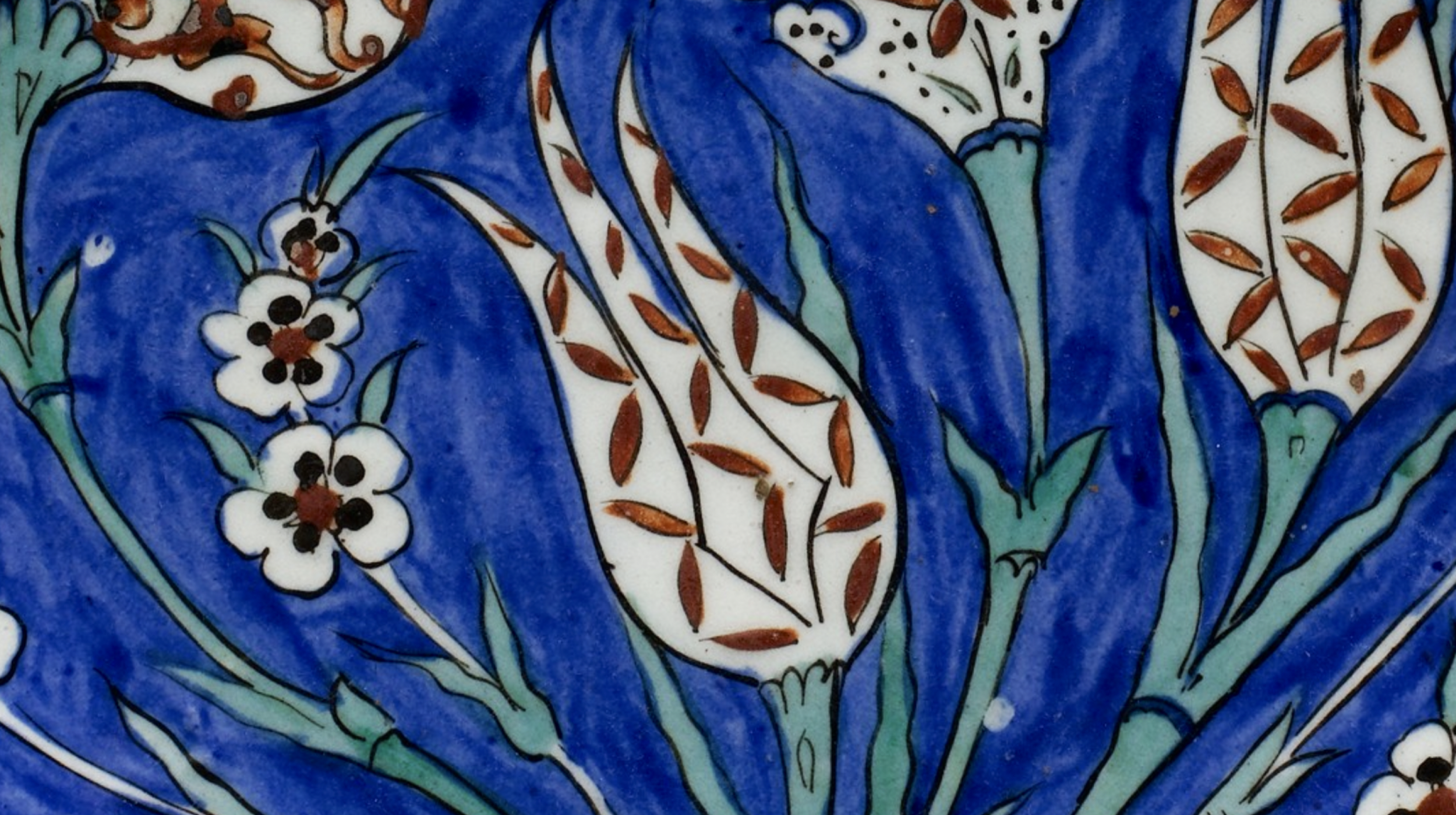
Iznik Blue-Ground Dish with Floral Design [detail], c. 1560, The Metropolitan Museum of Art. The structure of the Ottoman tulip as a decorative motif followed consistent conventions. It was typically rendered with three curving petals, forming a waisted bloom that gently flares at the top.
THE TULIP IN THE OTTOMAN EMPIRE
In the sixteenth century, during Suleiman the Magnificent's reign, the tulip became a major symbol of Ottoman imperial culture. It appeared in various forms—on mosque tilework, court manuscripts, silk fabrics, and architectural decorations—featured in both sacred and secular spaces.
Within this context, the flower was intentional. Its inclusion in imperial buildings and luxury items reinforced a vision of order rooted in divine creation and sovereign authority.
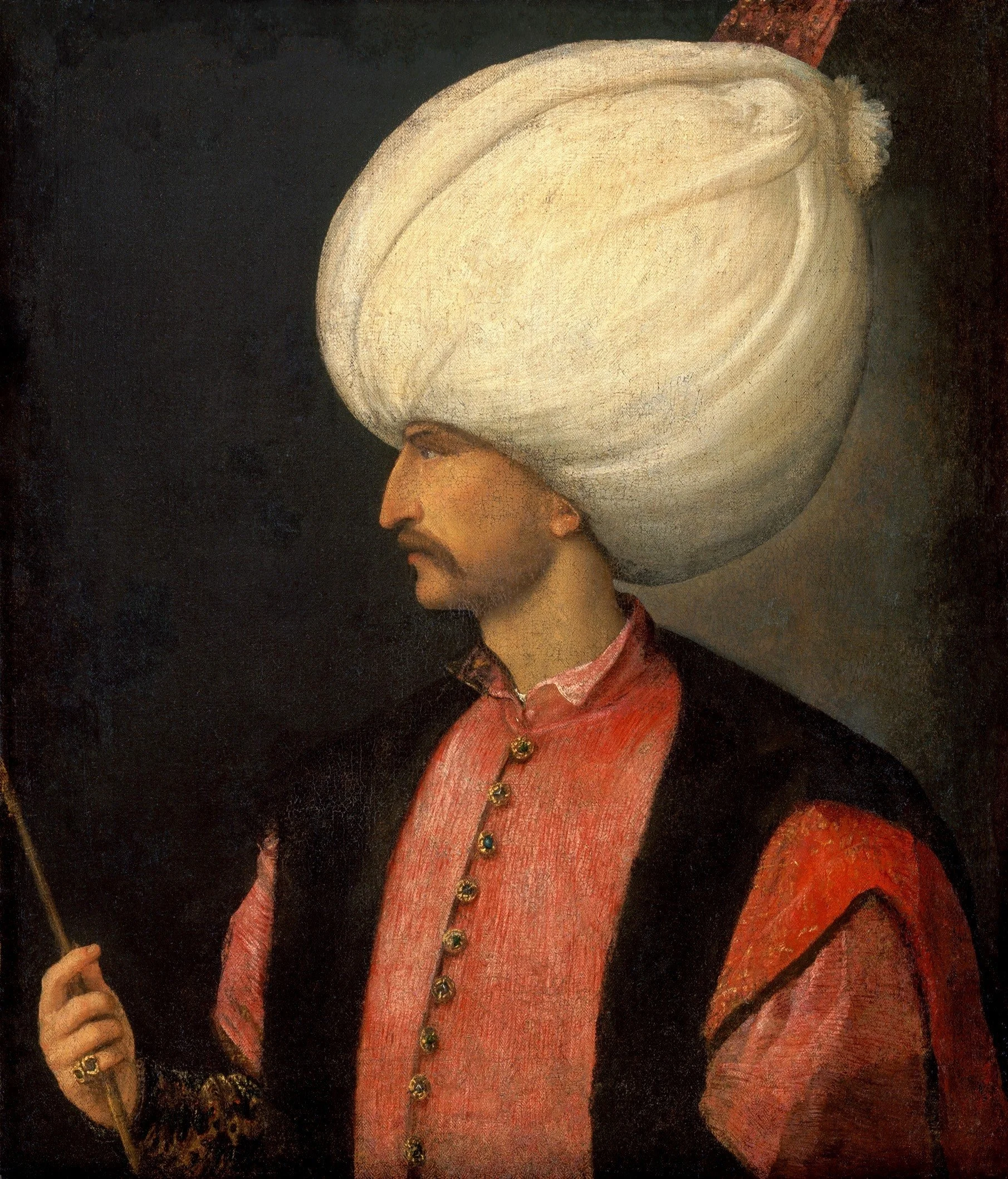
Portrait of Suleiman, c. 1530, Titian, Kunsthistorisches Museum, Vienna, Austria
Ottoman court art operated through highly controlled workshop systems. Motifs were selected, refined, and standardized. The tulip’s upright, disciplined form aligned naturally with architectural rhythm and calligraphic line. Its silhouette was instantly recognizable. Through repetition across buildings and objects, the flower became a visual marker of imperial authority.
The refinement of this floral language is closely linked to the artist Kara Memi, whose work helped establish what scholars call the Floral Style. Under his influence, flowers became more recognizable as botanical, while still remaining stylized and controlled. Earlier court designs depended on inherited motifs—stylized blossoms and scrolling forms inspired by Persian and East Asian traditions—rather than on clearly identifiable species. The tulip was no longer a generic plant form but a specific flower reduced to its essential structure.
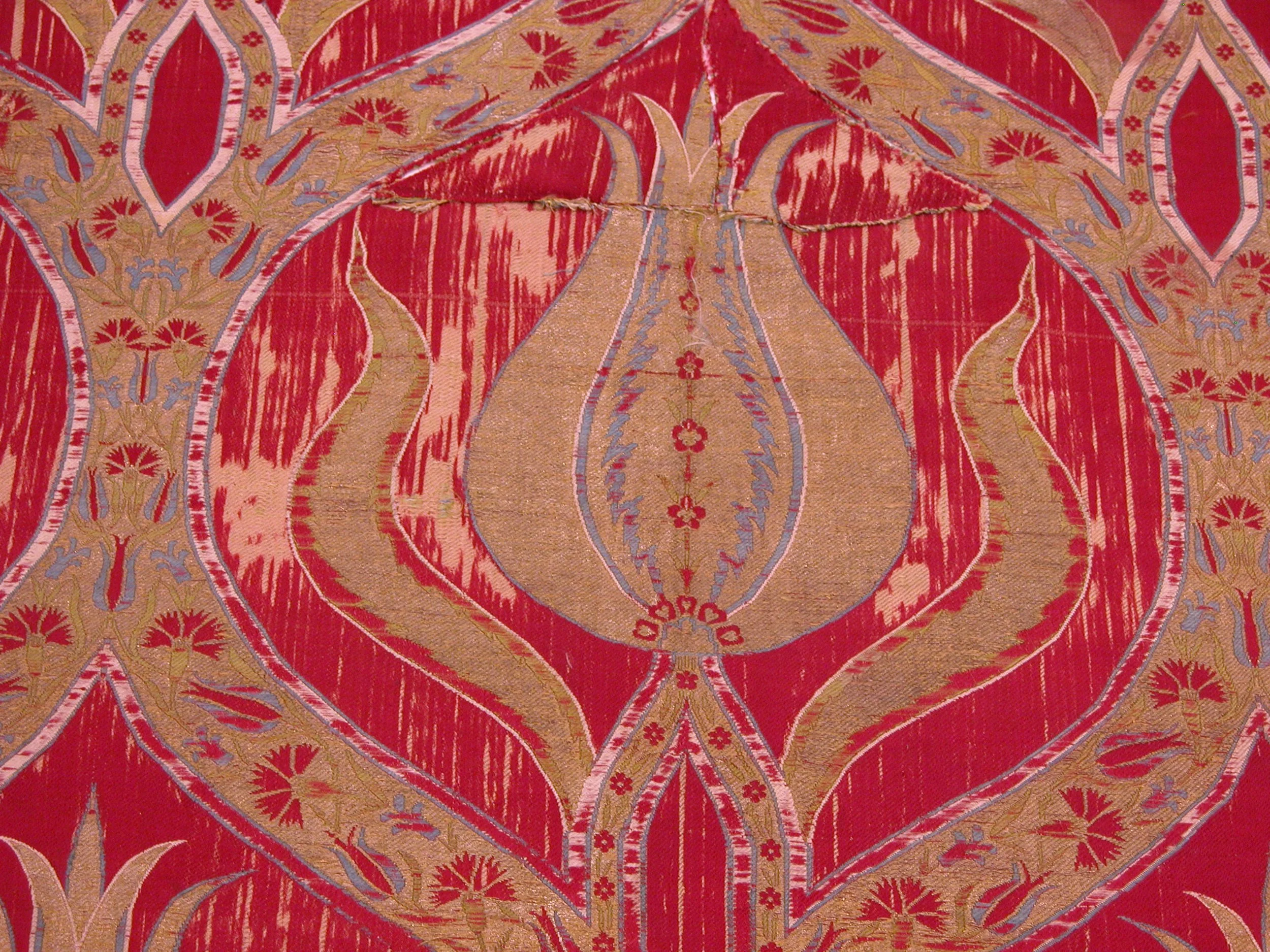
Ottoman silk and velvet textiles often feature large-scale designs displayed within the ogival framework. This example features an elongated tulip flanked by two wavy lines, divided by saz-style serrated leaves, and centered by tiny blossoms. Delicate carnations and tulips wind their way along vines inside the ogival lattice. Based on the shape of this 16th-century fragment, housed at the Metropolitan Museum of Art in New York, the lampas-woven silk (known as kemha in Turkish) was probably once part of a garment.
That structure followed consistent rules. Ottoman tulips were usually made of three curving petals, forming a waisted bloom that gently flares at the top. The motif could be created with just a few confident brush strokes, enabling repetition without losing clarity. Whether woven into silk or painted on ceramic, the form stayed consistent.
Ottoman court art was produced through highly controlled workshop systems, in which motifs were chosen, refined, and standardized. The tulip’s upright shape naturally matched architectural rhythm and calligraphic lines, making it instantly recognizable on buildings and objects.
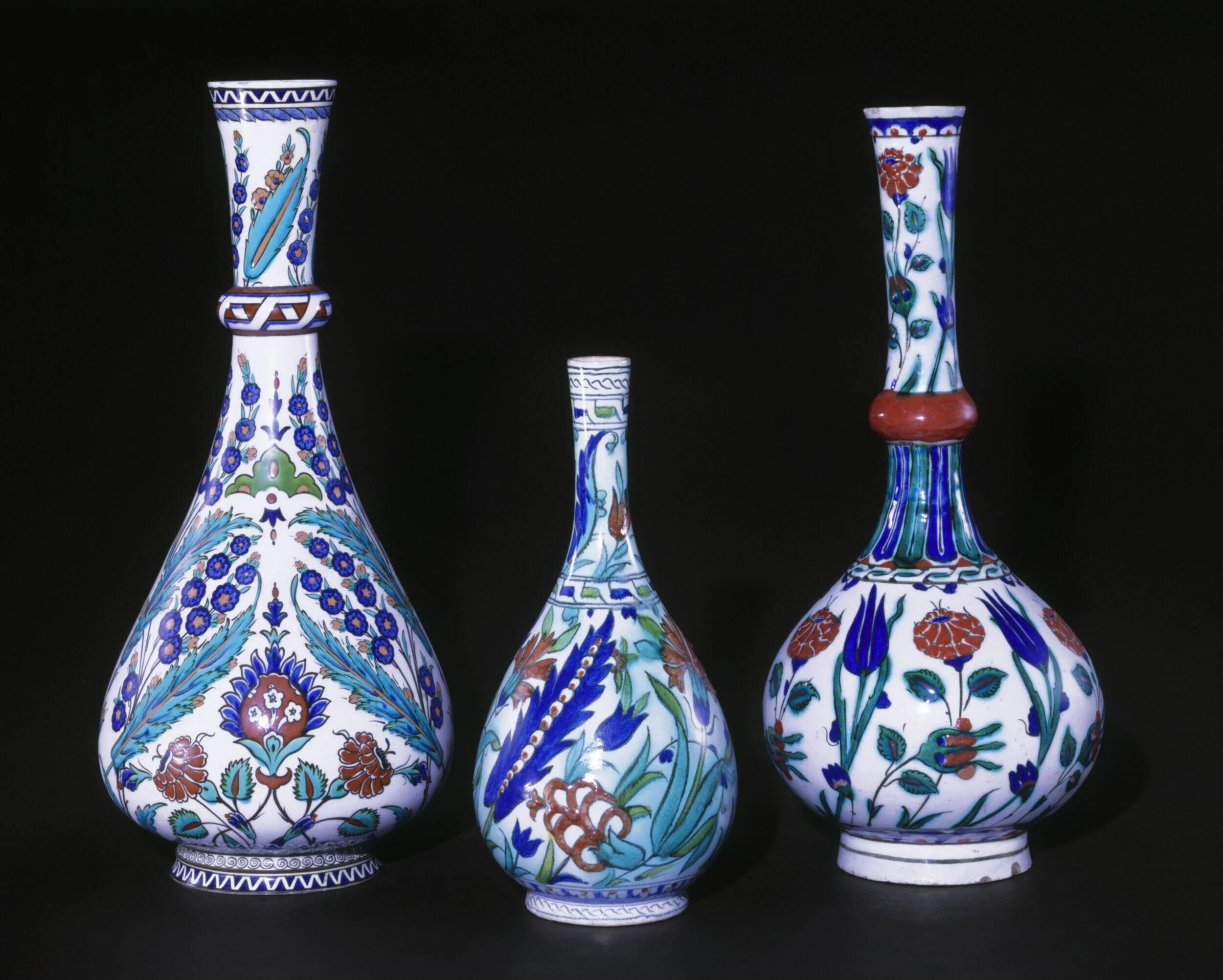
ABOVE: Ottoman Iznik bottles, 1575-1580 (made), © Victoria and Albert Museum, London; BELOW LEFT: Iznik Dish Depicting Two Birds among Flowering Plants, c. 1575–90, The Metropolitan Museum of Art, New York; BELOW RIGHT: Iznik Tankard, c. 1580-1600, © Victoria and Albert Museum, London
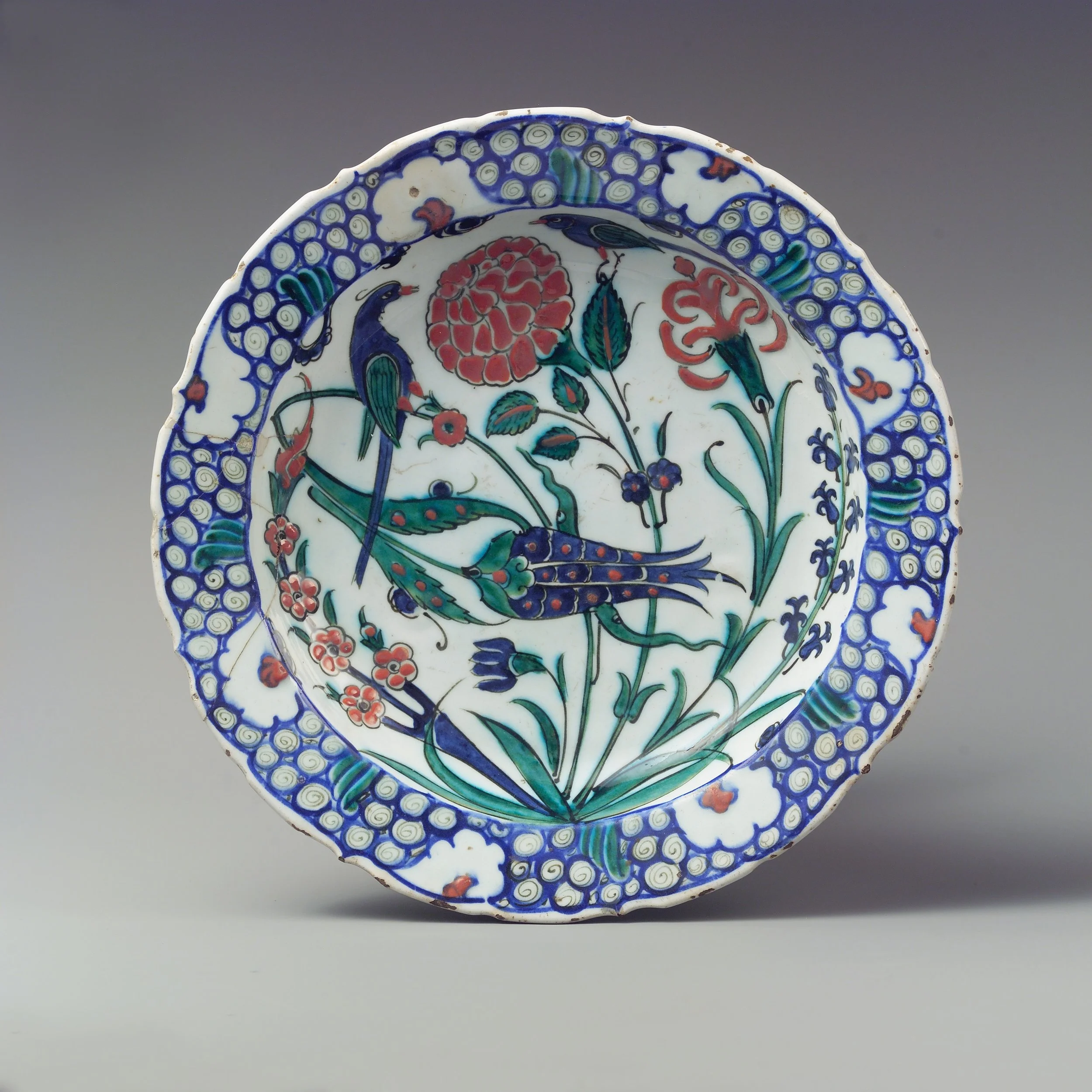
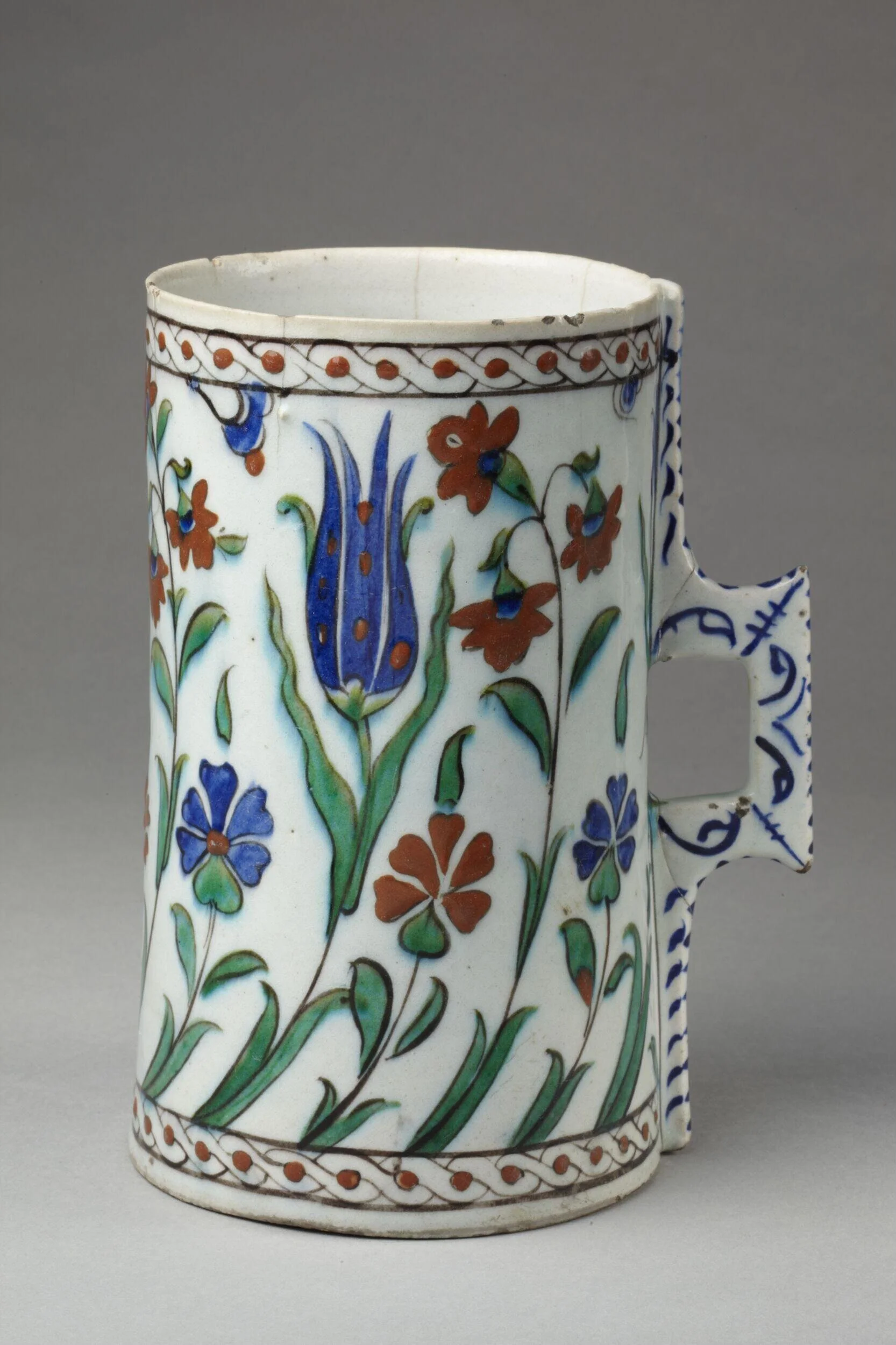
Material choices reinforced this clarity. Cobalt blue—one of the earliest and most stable pigments in the Iznik palette—was widely used for floral motifs because it could withstand high-temperature firing. As the palette expanded to include turquoise, emerald green, and the distinctive raised red, tulips appeared in bold combinations, often sharply outlined against a luminous white ground.
Tulips are most prominently featured in the stunning tile works created in Iznik workshops during the sixteenth century. These underglaze-painted ceramics transformed mosque interiors into vibrant fields of color. In structures like the Süleymaniye Mosque and the Rüstem Pasha Mosque, tulips rise rhythmically across walls, framing windows, mihrabs, and domed areas. Repeated in cobalt blue, turquoise, emerald green, and raised red, the flower becomes an architectural element.
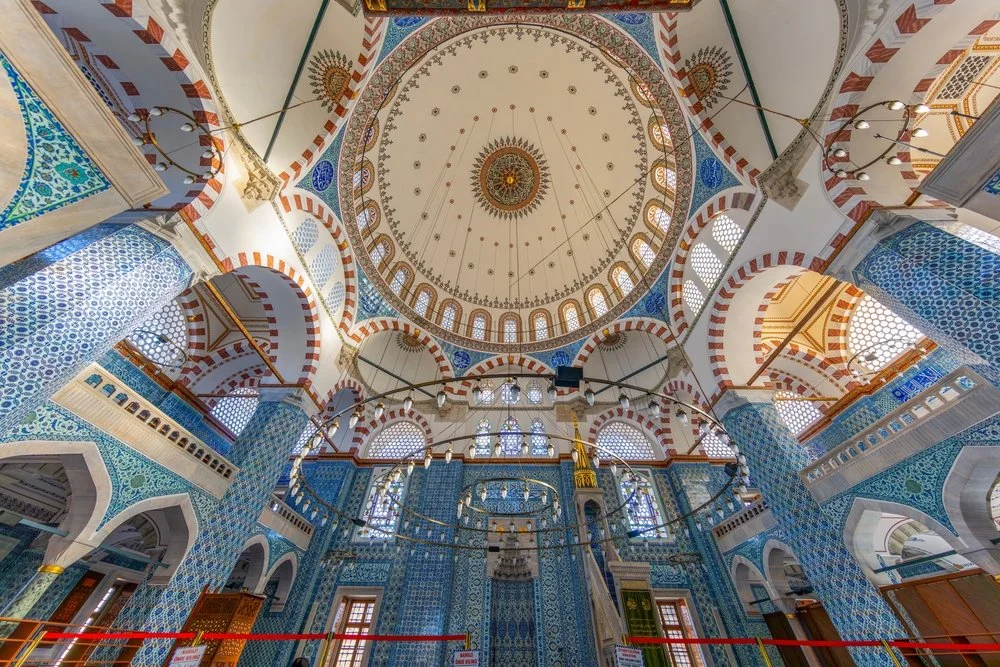
Interior of Rustem Pasha Mosque (Rustem Pasa Camii) in Istanbul, Turkey with its famous Iznik blue-tiled walls.
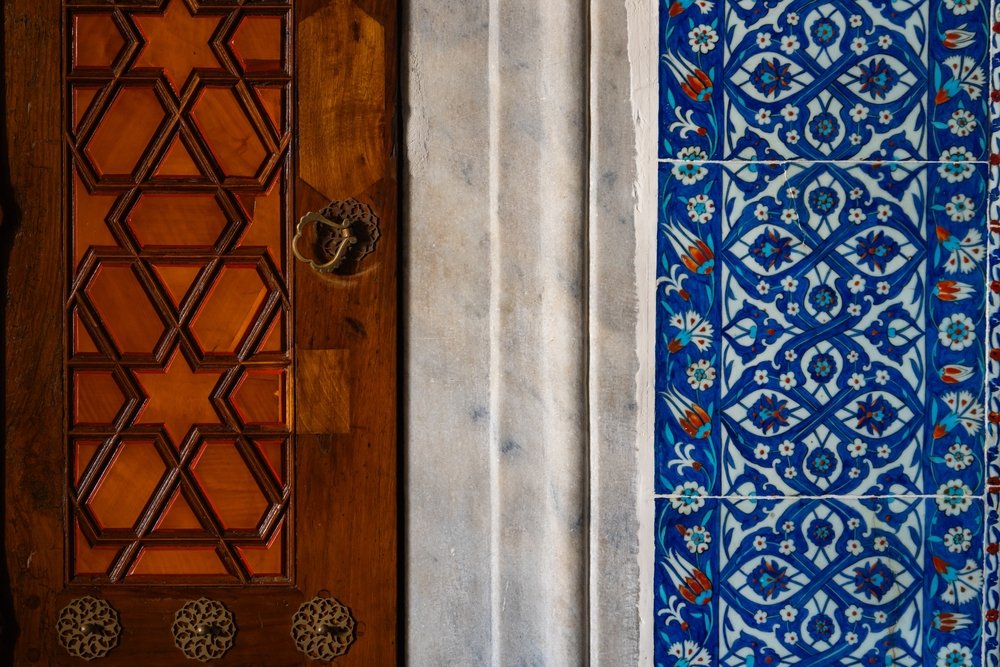
Tiled wall with tulip border at Rustem Pasha Mosque (Rustem Pasa Camii), Istanbul Turkey. Image Source: Shutterstock
THE TULIP AS BOTANICAL MARVEL
By the mid-sixteenth century, tulips were growing in European gardens. Their unfamiliar form—bold color, smooth petals, upright stance—distinguished them from the meadow and woodland flowers Europeans were accustomed to seeing. The tulip did not resemble a daisy, a violet, or a wild rose. It looked deliberate.
In 1561, Swiss naturalist Conrad Gesner published the earliest printed image of a tulip in Europe. His woodcut depicts the flower isolated against a blank background: a straight stem, a clearly outlined bloom, and leaves rendered with care. There is no decorative setting or ornamental repetition. The goal is accuracy.
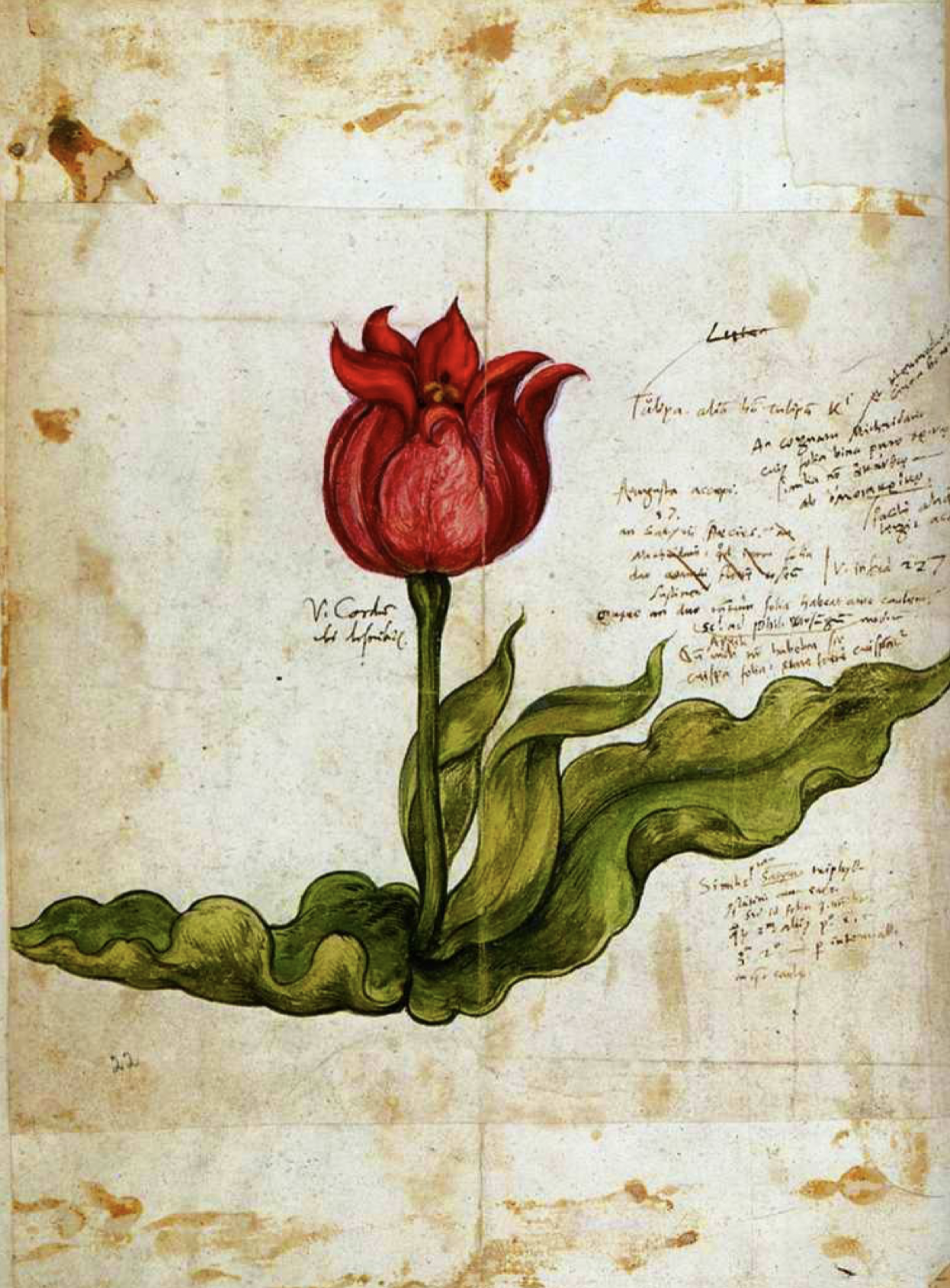
Conrad Gesner's red tulip formed part of a monumental botanical encyclopedia compiled between 1555 and 1565. To complete it, Gesner assembled nearly 1,500 plant drawings — most of them his own — remarkable for their scientific precision and detailed annotations on structure and habitat. He died of the plague before seeing it published. Of the nearly 1,500 illustrations, only two depicted tulips, a reflection of how rare and newly arrived the flower still was in Europe at the time.
Around the same time, the Flemish botanist Carolus Clusius was cultivating tulips and studying plants at the University of Leiden’s botanical garden. His work helped establish the flower within the emerging field of natural history, where plants were measured, compared, and named. Illustration served as evidence.
“The tulip is not just a flower, it is a work of art, a masterpiece of nature.”
The tulip enters European visual culture within this framework—as something to be recorded, not repeated. Its rarity and unfamiliarity made it worth documenting.
This was also the moment of the herbal and the cabinet of curiosity, where scholars sought to catalogue an expanding natural world: newly encountered plants, shells, minerals, and objects arriving through trade and exchange.
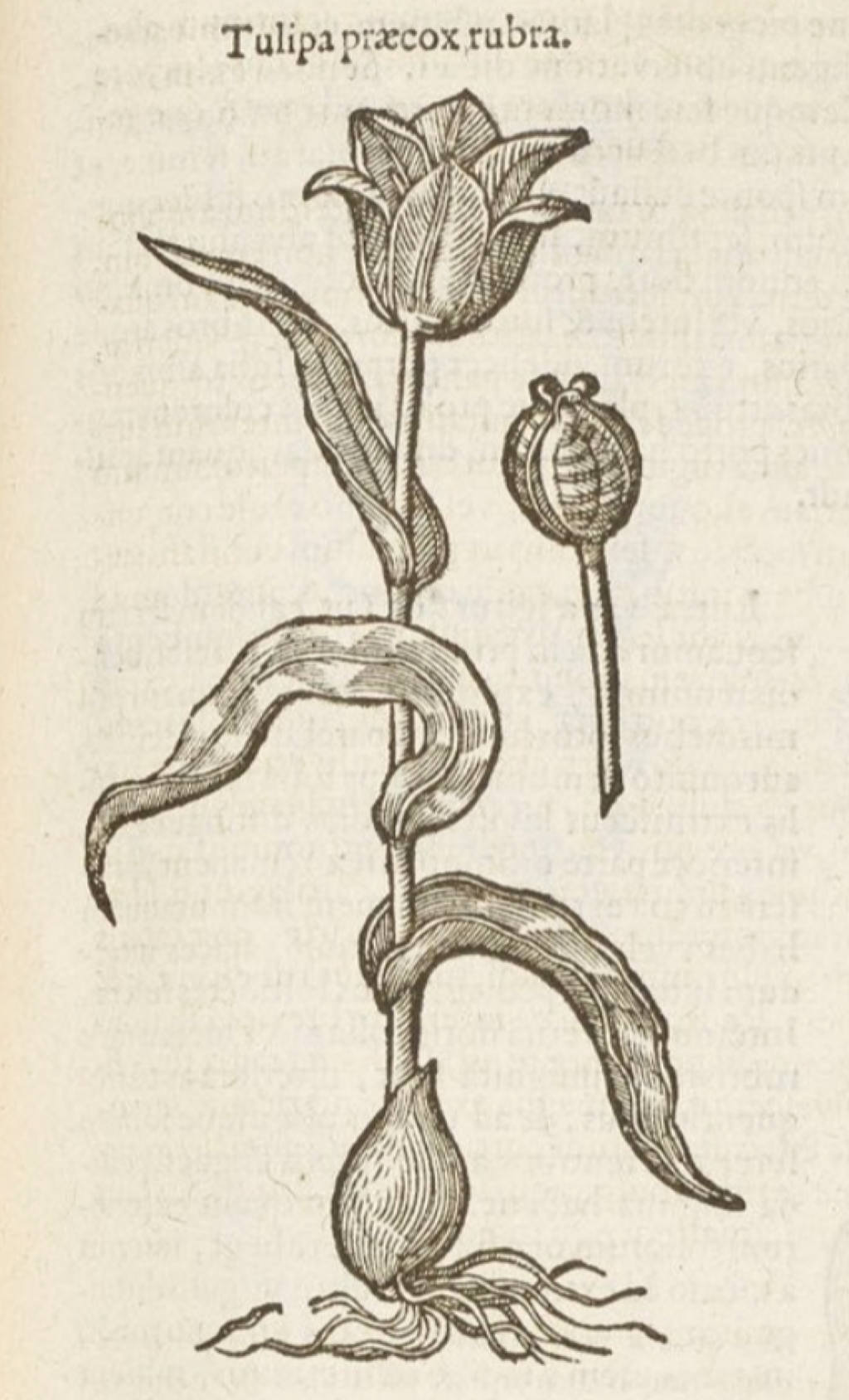
Tulipa praecox ruba from Carolus Clusius's Rariorum plantarum historia, 1601, © Royal Collection Enterprises Limited 2024 | Royal Collection Trust
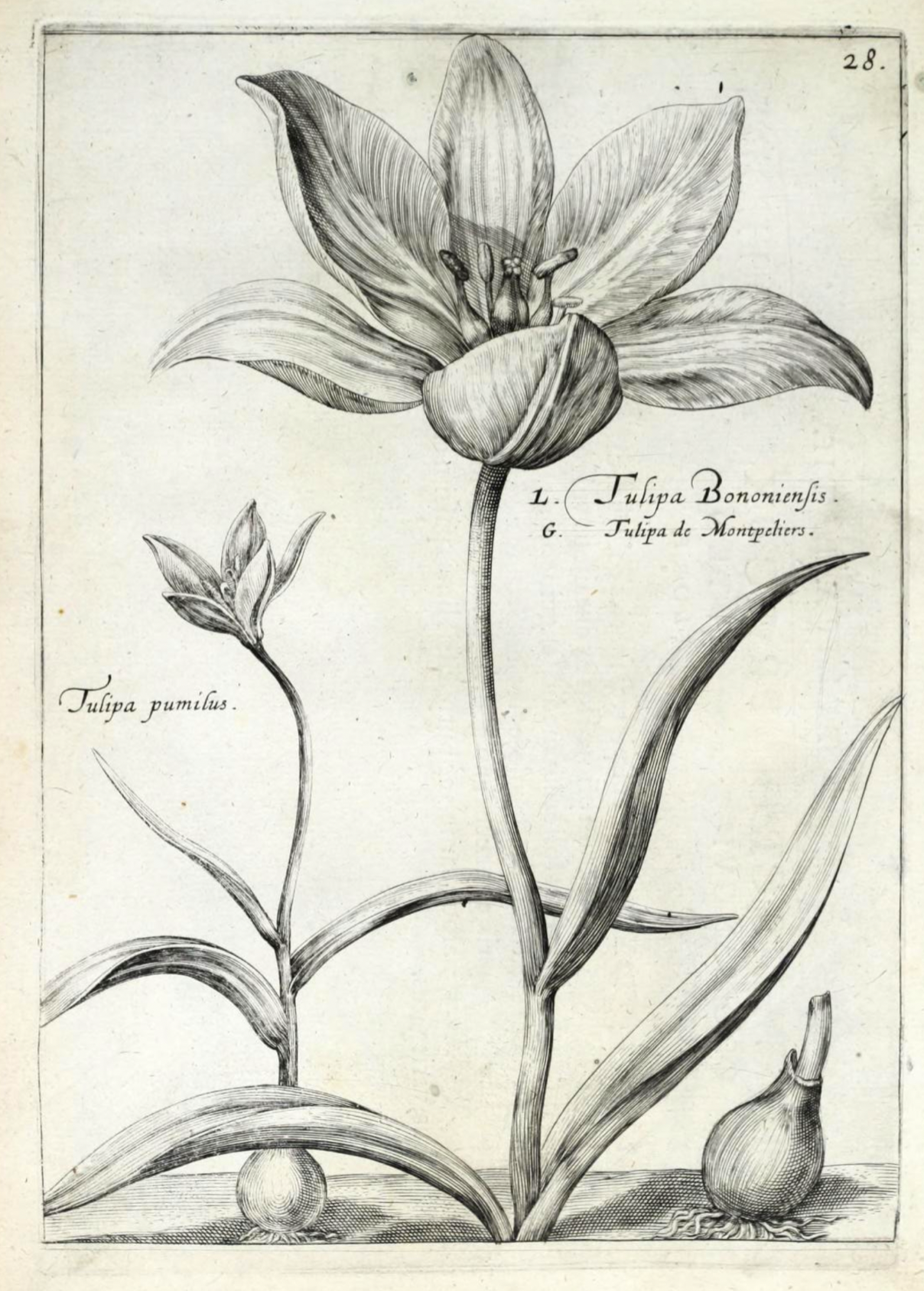
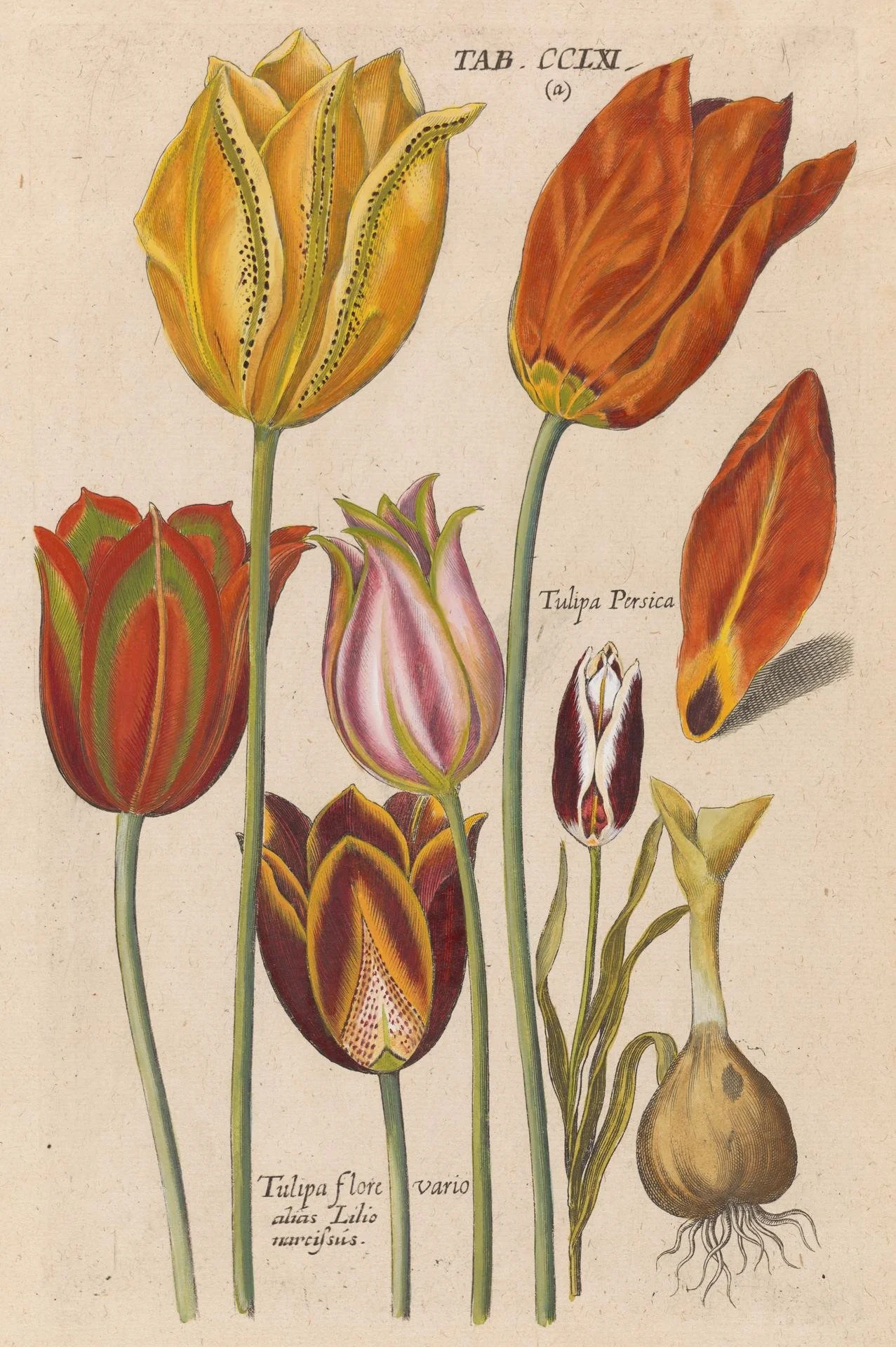
By the late sixteenth century, a new type of publication appeared: the florilegium. Unlike practical herbals and botanical monographs, which focused on medicinal uses and classification, florilegia celebrated decorative flowers. They displayed blooms as individual portraits, often arranged on clean pages, labeled, and appreciated.
In works by artists such as Crispin van de Passe the Elder and Emmanuel Sweert, tulips are carefully depicted, sometimes with named varieties. The focus shifts subtly from classification to cultivation. These were not wild plants; they were garden creations.
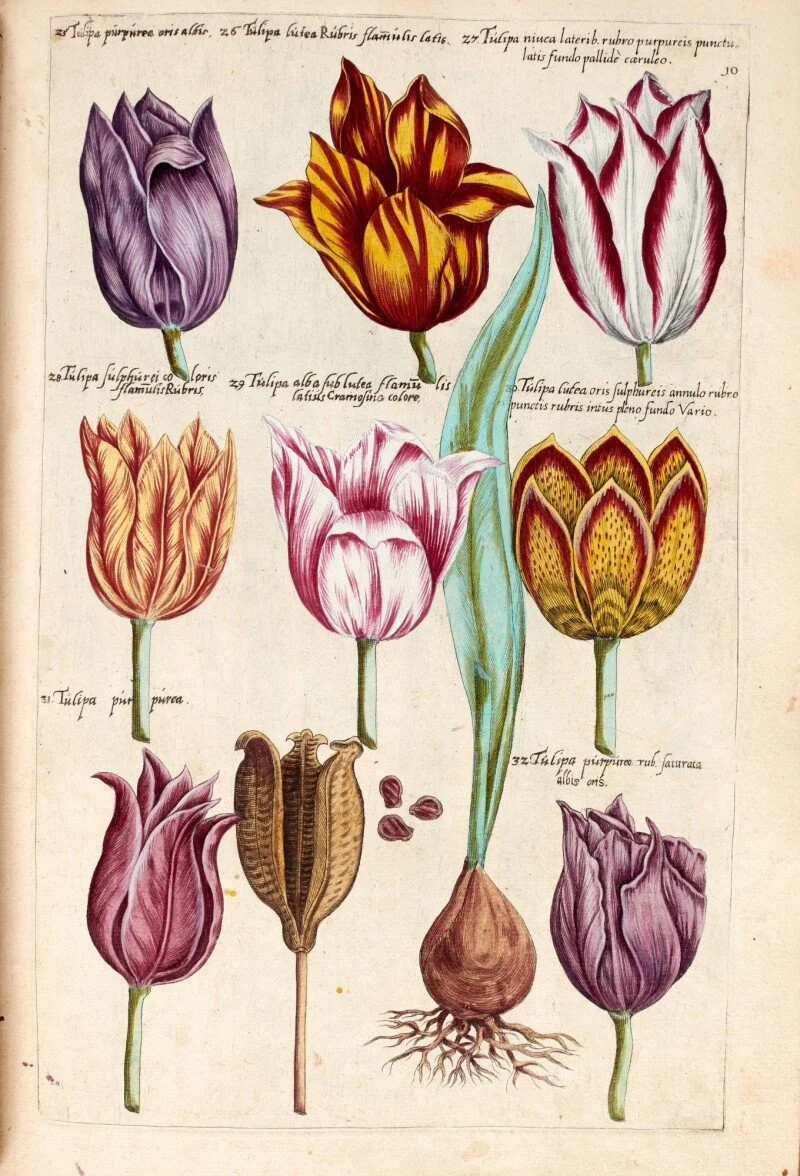
ABOVE: Emanuel Sweert, Florilegium, 1612, hand colored plates, private collection; BELOW LEFT: Hortus floridus (Garden of Flowers), Plate 28, 1614, Crispijn van de Passe, Getty Research Institute; BELOW RIGHT: Tulips, from Florilegium novum (New Book of Flowers), c. 1612, Johann Theodor de Bry, Yale University Art Gallery, New Haven, Connecticut
“Tulip books” followed, documenting prized varieties owned by collectors and growers. Each bloom was distinguished not only by its structure but also by its coloring. These albums were not merely documentary; they were works of art in their own right. The flower remains a specimen, but it is now also a prized possession.
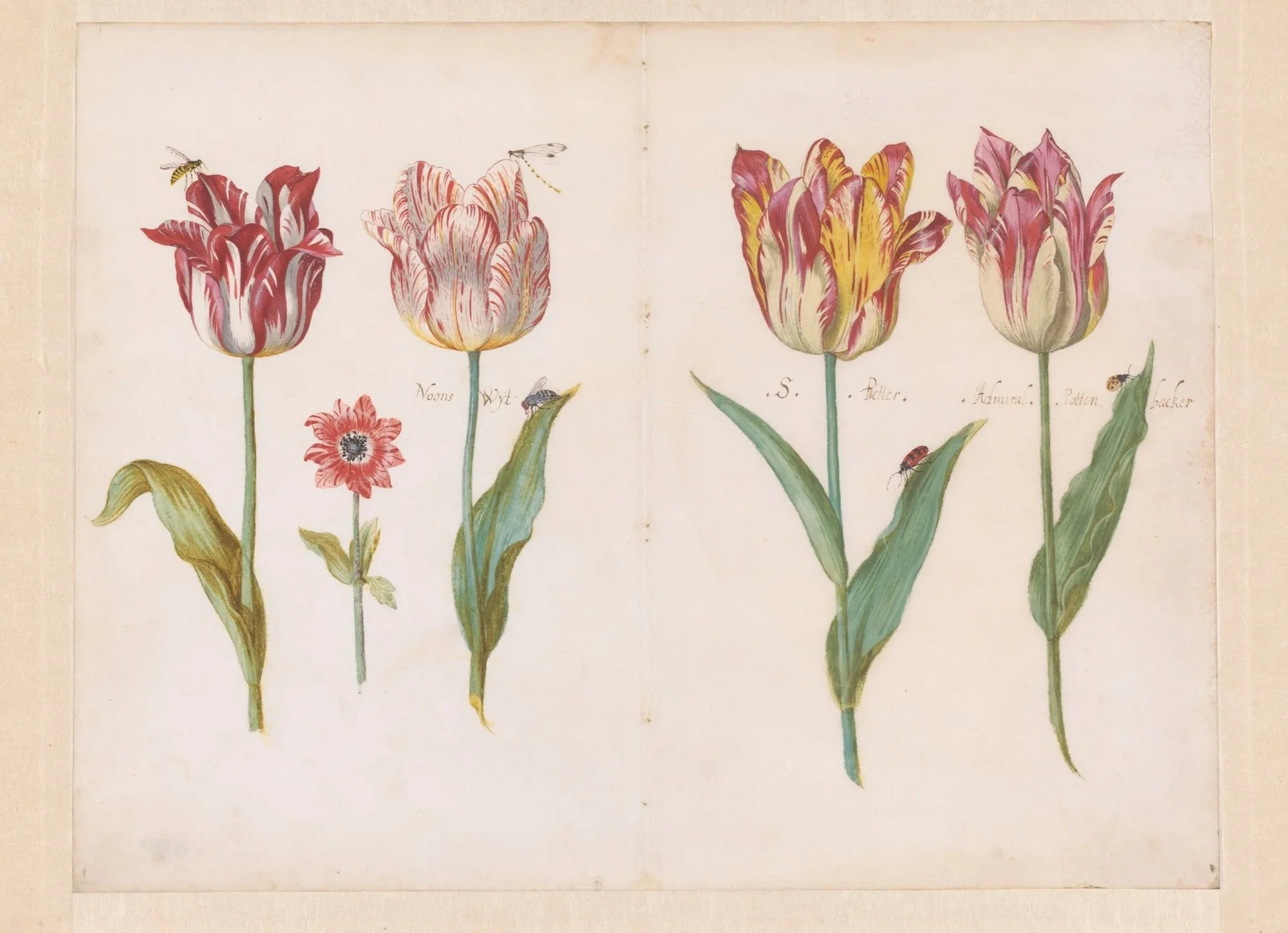
Sheet from a Tulip Book, c. 1640, Jacob Marrel, Rijksmuseum, Amsterdam. Flowers were costly, and tulips the costliest of all. Tulip bulbs were avidly collected in the 17th century and large sums changed hands for unusual specimens. The tulip book’s exact function is not known. It could have been a catalogue from which an interested buyer made his selection, or a drawn inventory of a collection of tulips.
THE TULIP AS POSSESSION: DUTCH STILL LIFE
In the early seventeenth century, the Dutch Republic fostered a lively culture of collecting. Wealthy merchants and professionals filled their homes with paintings, shells, maps, curiosities, and cultivated plants. Gardens served as an outdoor extension of this impulse, where rare and desirable specimens could be grown, compared, and displayed. Tulips, especially rare striped varieties, were named, exchanged, and carefully bred, with subtle differences in color and shape marking their distinctiveness.
Within this environment, the floral still life became a painted version of a cabinet of curiosity. It brought together prized flowers from different places into one image, assembling blooms that could not coexist in real life. A spring tulip might appear alongside a summer rose or an autumn chrysanthemum, creating a display no garden could sustain.
Part of the appeal was in the looking. These paintings invited close attention. Viewers could study each bloom, recognize varieties, and take pleasure in knowing what they were seeing.
Ambrosius Bosschaert the Elder was a pioneer of this genre. He helped establish the clear, structured compositions that defined early Dutch flower painting and trained the next generation of artists. His bouquets are tightly arranged against dark backgrounds, with each flower carefully rendered and easy to examine.
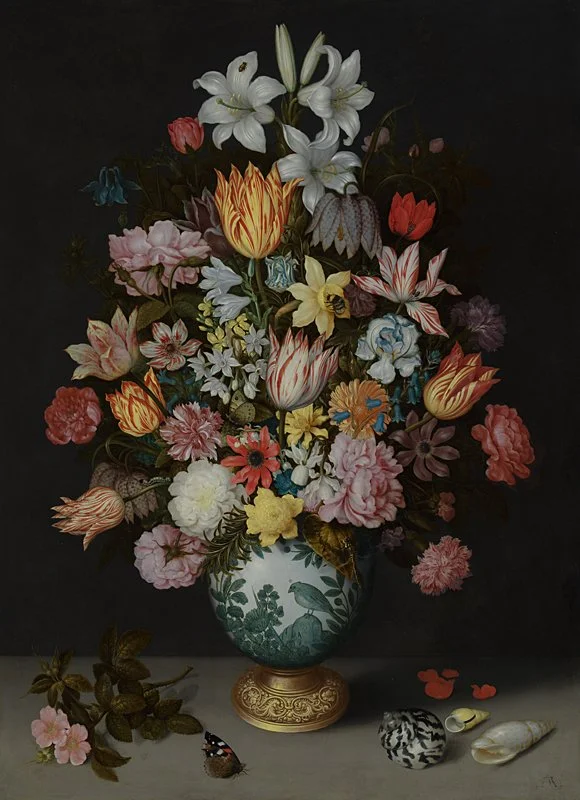
A Still Life of Flowers in a Wan-Li Vase, 1609-10, Ambrosius Bosschaert the Elder, The National Gallery, London
Tulips, in particular, signaled wealth. The most valuable bulbs were extremely costly, often well beyond what most people could afford to grow. A painting was much cheaper. It provided a way to enjoy the flower without the expense of ownership.
That is evident in how tulips are depicted. They are not simply included; they are made to stand out. A bouquet typically includes at least three, with one rising above the rest, often positioned toward the upper right. In many paintings, that tulip is taller than a real stem could support, extending above the other flowers to attract attention. This effect is purposeful. A striped, or “broken,” tulip is placed where it cannot be overlooked, signaling rarity.
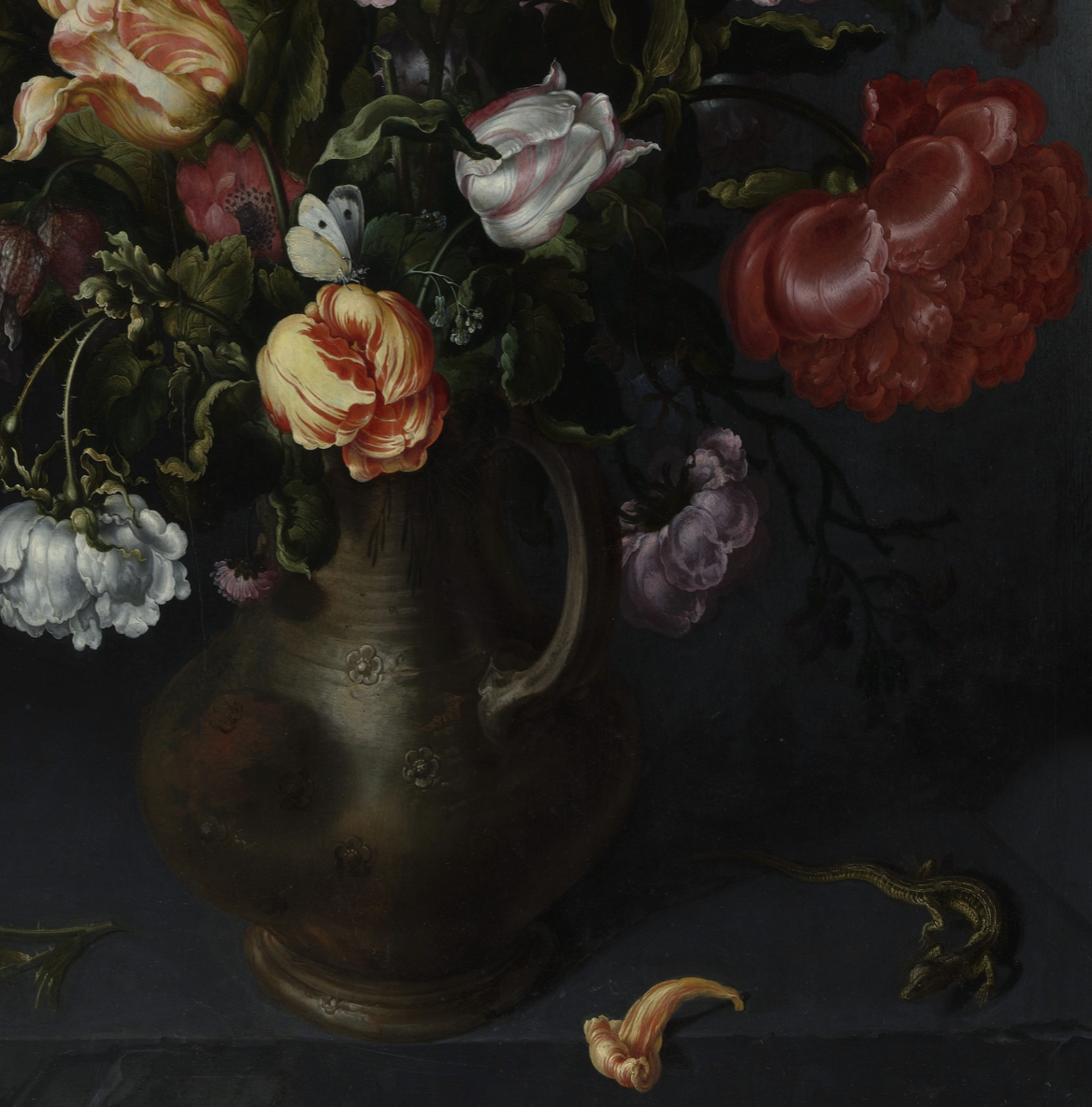
However, these paintings rarely portray beauty without some form of tension. Floral still lifes often adhere to the broader Dutch tradition of memento mori — reminders of mortality woven into scenes of abundance. A fallen petal, a browning leaf, or a small insect nibbling at the edge of a bloom interrupts the display. Even the tulip, so carefully arranged and highly valued, is a cut flower. Its dramatic height and vivid color only emphasize its fragility. The bouquet celebrates cultivated achievement but also recognizes that beauty fades and possessions are temporary.
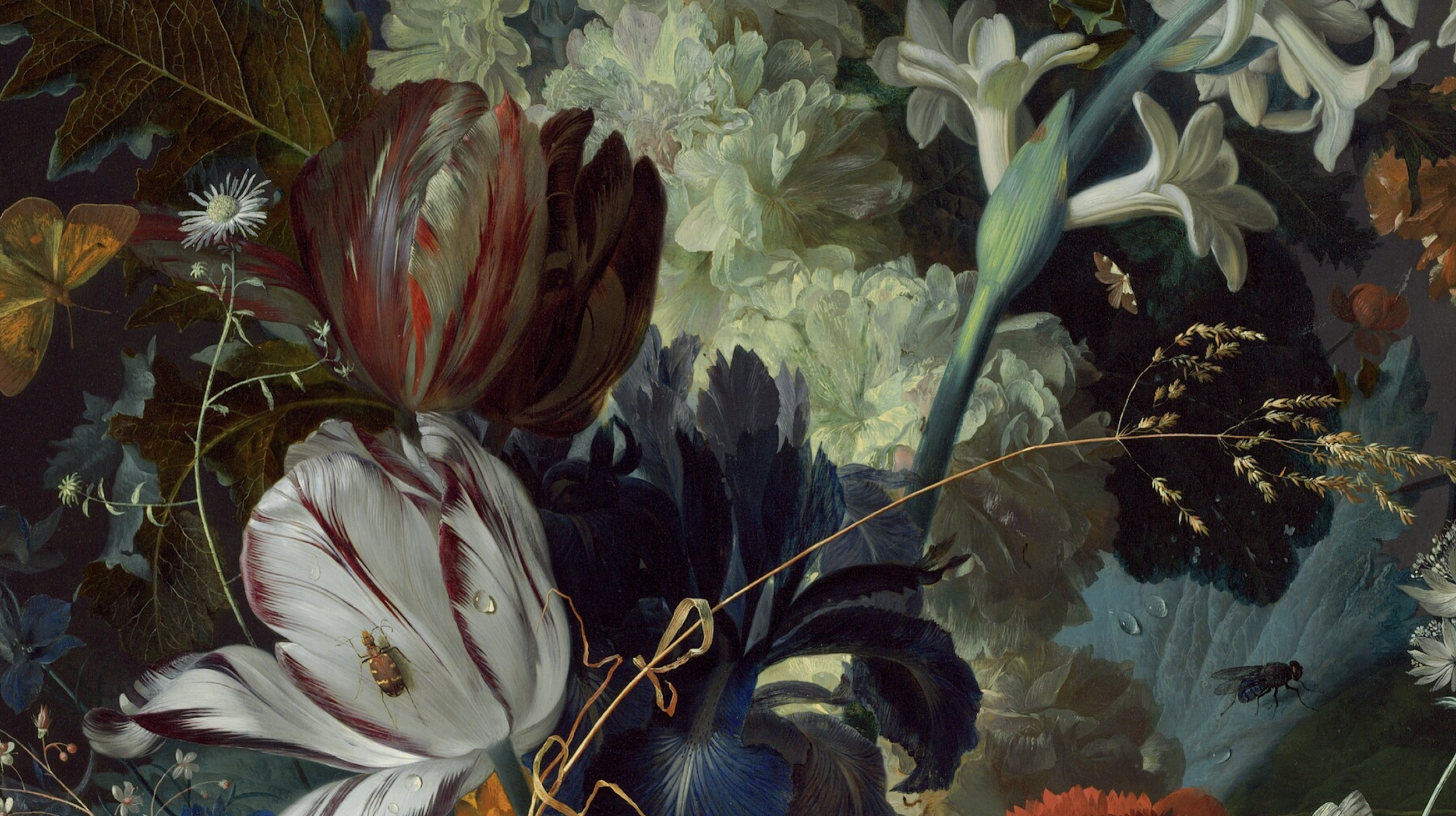
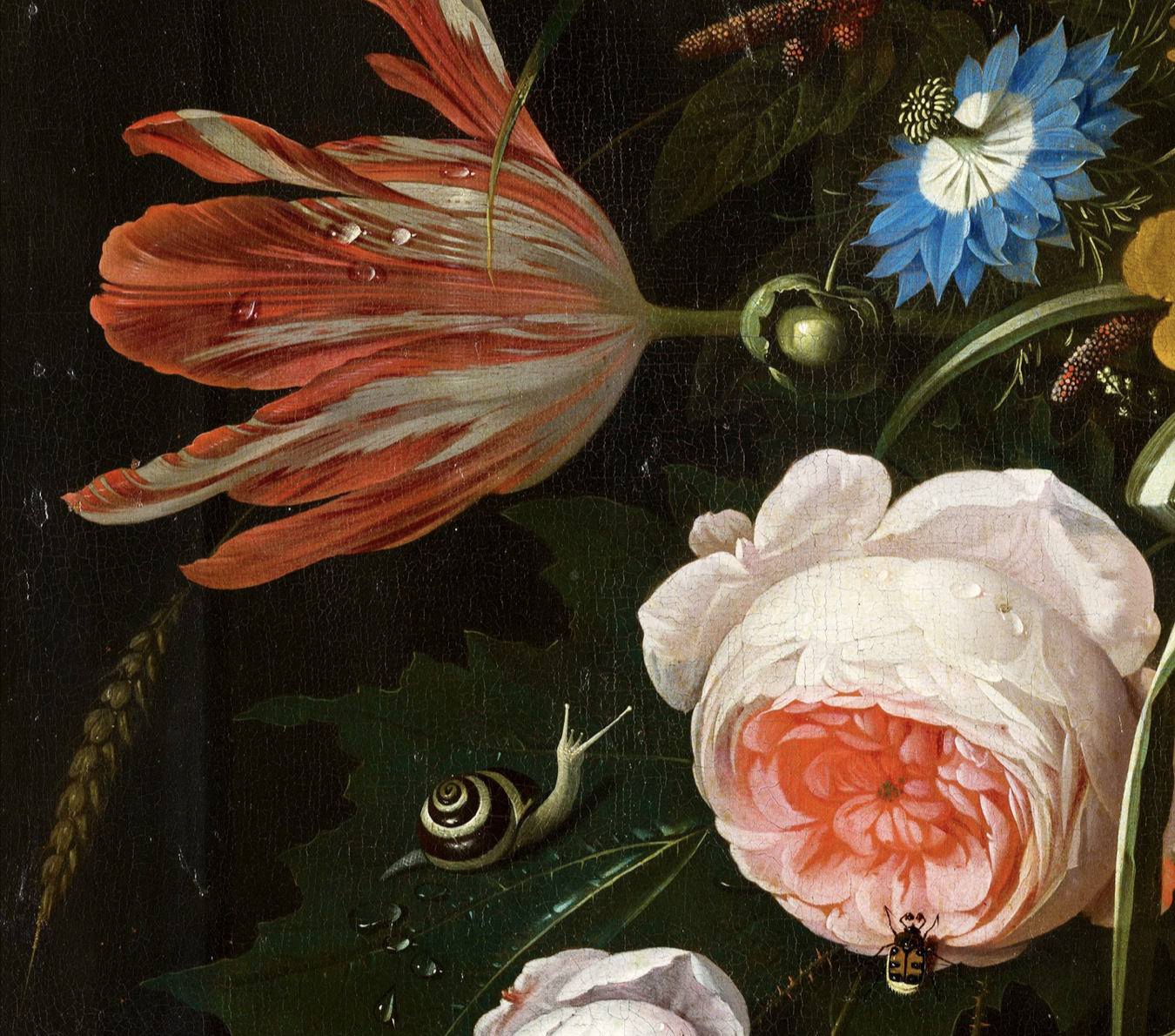
ABOVE: Still Life with Flowers and Fruit [detail], c. 1715, Jan van Huysum, National Gallery of Art, Washington D.C.; BELOW LEFT: Flower Still Life [detail], 1669, Maria van Oosterwijck, Cincinnati Art Museum; BELOW RIGHT: A Vase with Flowers [detail], Jacob Vosmaer, probably 1613, The Metropolitan Museum of Art, New York
In the work of Jan Brueghel the Elder, this tension becomes more elaborate. If anyone could overstuff a vase with the impossible, it was Brueghel. His bouquets gather flowers from different seasons, climates, and stages of bloom into a single, meticulously balanced composition. Tulips rise among lilies, roses, and exotic blossoms, each rendered with jewel-like precision. The abundance is dazzling — and deliberately artificial.
That artifice heightens the meaning already embedded in the genre. Brueghel does not simply include symbolic elements; he multiplies them. Insects crawl across petals. A blossom droops at the edge of perfection. The contrast between vitality and decay grows sharper precisely because the arrangement is so extravagant. The tulip, lifted high and painted with clarity, remains a cut bloom — its rarity amplified, its fragility unavoidable. The more spectacular the display, the more pointed the reminder.

Flowers in a Wooden Vessel, 1606-1607, Jan Brueghel the Elder, Kunsthistorisches Museum, Vienna
Still life was one of the few professional fields where women could achieve lasting artistic success. Prestigious history painting required formal academic training, participation in guild systems, and studying the nude figure — access to which was mostly blocked for women by social and institutional barriers. Portraiture relied on elite patronage networks that were hard to enter on their own. Still life, on the other hand, could be created within domestic or semi-domestic spaces and didn't require studying the male anatomy. Despite these restrictions, women turned the genre into a display of technical skill and intellectual depth.
Several female painters gained international recognition and commanded prices that matched, and sometimes exceeded, those of prominent male contemporaries. Among the most acclaimed was Maria van Oosterwijck (1630–1693). Working in Amsterdam, she built an independent career despite being barred from formal guild membership because of her gender. Born into a wealthy family of ministers, she remained unmarried and dedicated herself fully to her studio work. Her clients included European royalty: King Louis XIV of France, Emperor Leopold I of Austria, and William III of England, all of whom purchased her art.
Van Oosterwijck’s paintings are meticulously constructed and densely symbolic. She favored dramatic contrasts between dark backgrounds and brightly lit blooms. Tulips appear alongside roses, peonies, and rare exotics, but their brightness is balanced by vanitas imagery. Butterflies hover, insects crawl, and wilting leaves curl at the edges of the arrangement. Skulls and hourglasses are placed among marble ledges painted with trompe l’oeil, some inscribed with signatures that seem carved into stone. Illusion and mortality coexist. The tulip, luminous and carefully placed, becomes part of a carefully staged meditation on time and inevitability.

Bouquet of Flowers in a Vase, c. 1670s, Maria van Oosterwyck, Denver Art Museum
A generation later, Rachel Ruysch came to symbolize a broader stylistic shift in late seventeenth-century floral painting. Throughout this period, bouquets became looser and less rigidly symmetrical. Instead of upright, carefully centered arrangements, artists increasingly favored asymmetry, diagonal movement, and overlapping stems. Light intensified against velvety backgrounds, and compositions grew more dynamic. Ruysch’s work illustrates this evolution.
The daughter of an Amsterdam anatomist and botanist grew up immersed in scientific collections and developed a keen eye for observation. In her paintings, stems cross and bend; petals lean toward and away from the viewer; blossoms seem to breathe within space. Signs of fragility remain, but they are blended into heightened naturalism rather than presented as explicit symbols. Tulips still appear, though they no longer serve as singular trophies of rarity. Instead, they are integrated into a mature, flowing pictorial language shaped by movement and attentive observation.
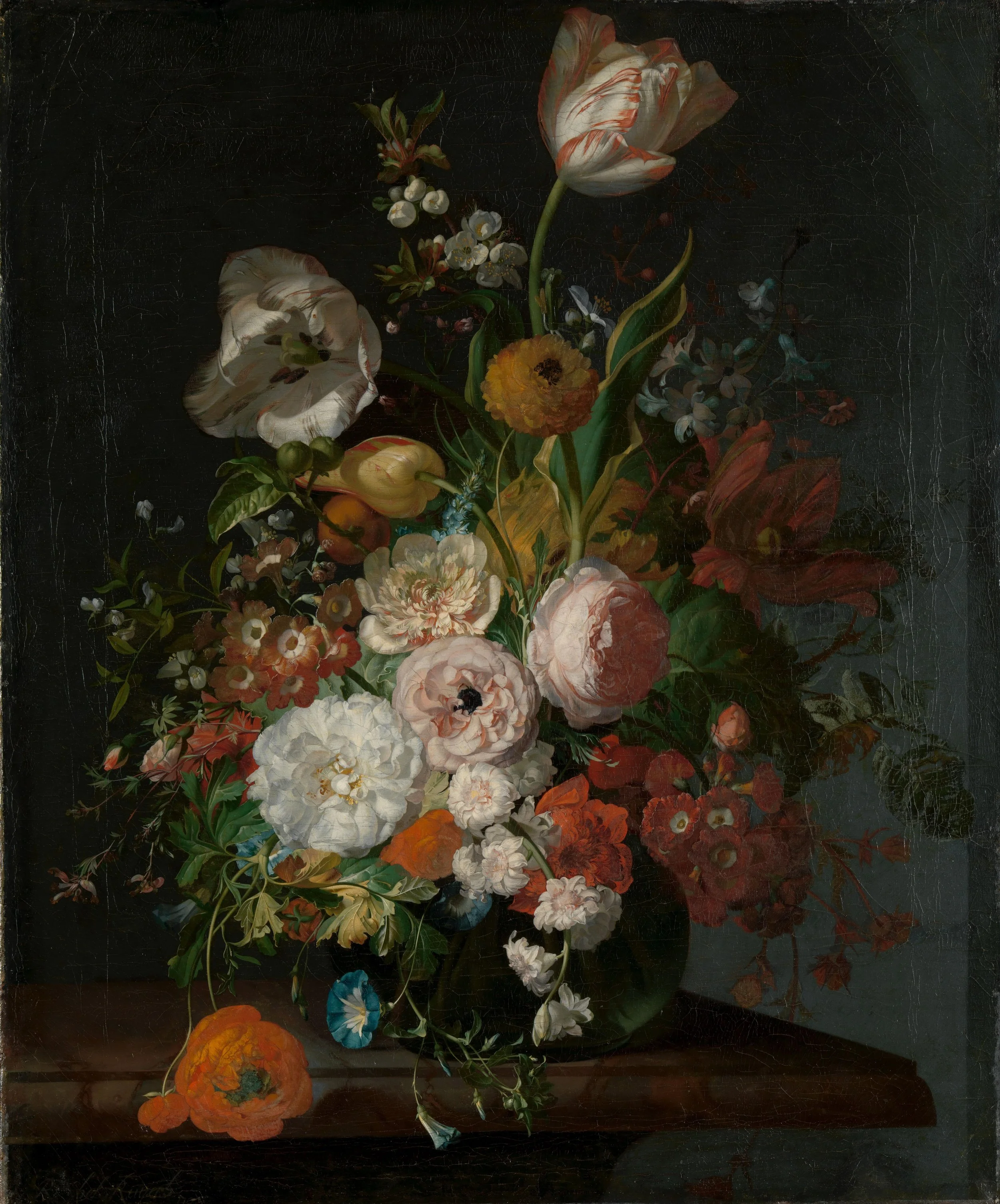
Still Life with Flowers in a Glass Vase, c. 1690 - c. 1720, Rachel Ruysch, Rijksmuseum, Amsterdam
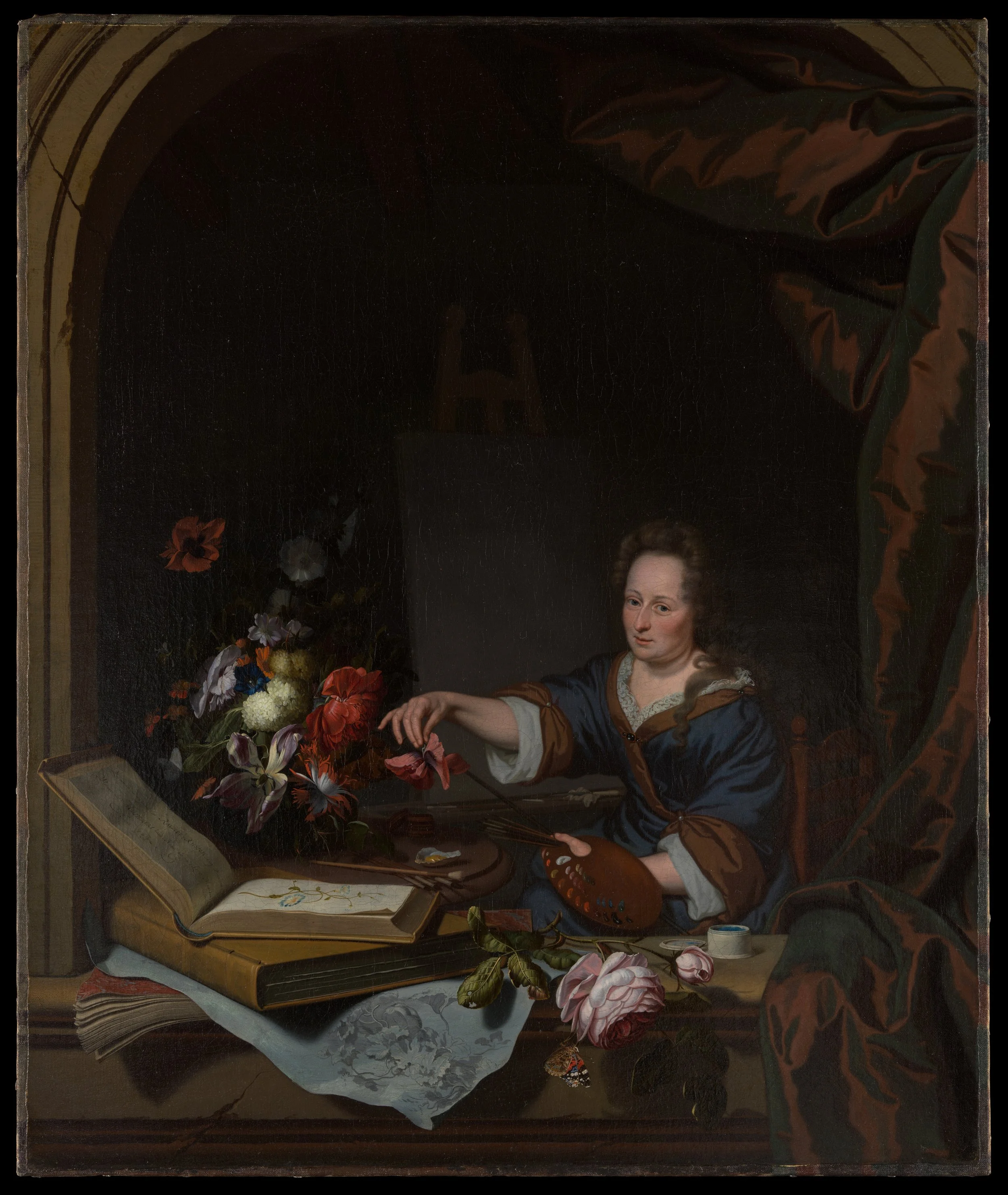
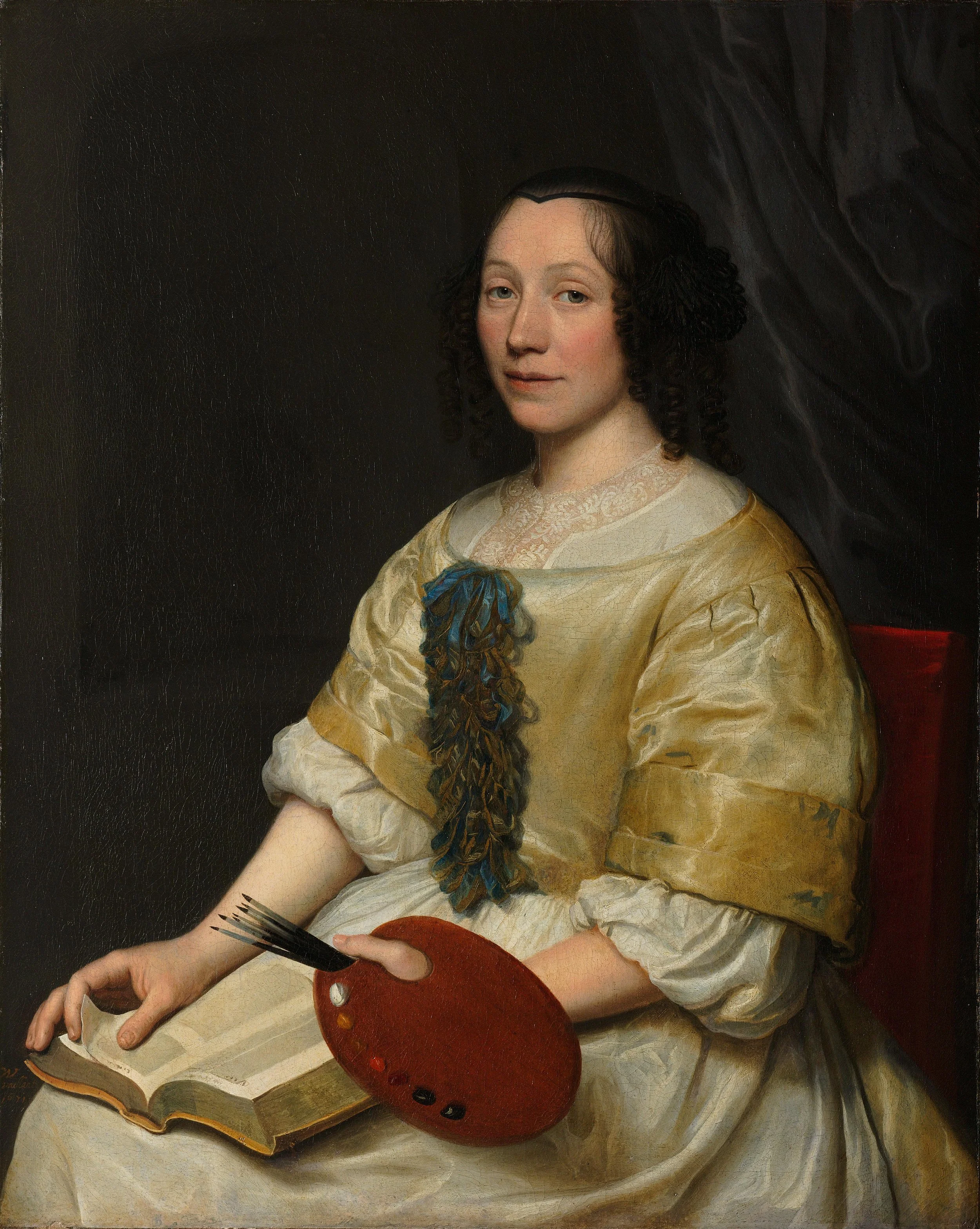
LEFT: Portrait of Maria van Oosterwijck, 1671, Wallerant Vaillant, Rijksmuseum, Amsterdam; RIGHT: Rachel Ruysch (1664–1750), 1692, Rachel Ruysch and Michiel van Musscher, The Metropolitan Museum of Art, New York
TULIPS & BOTANICAL ILLUSTRATION DURING THE ENLIGHTENMENT
By the eighteenth century, the tulip was well established in European horticulture. It was no longer a rare or speculative obsession. Instead, it became part of a larger intellectual movement: the Age of Reason. This was a time characterized by classification, scientific investigation, and global botanical exploration.
Botanical exploration expanded through imperial networks. Figures like Joseph Banks, who traveled with Captain Cook and later led the Royal Society, helped institutionalize plant collection and documentation. Gardens became sites for experimentation. Species were cataloged, compared, and classified. The cultivated flower was no longer just admired — it was studied.

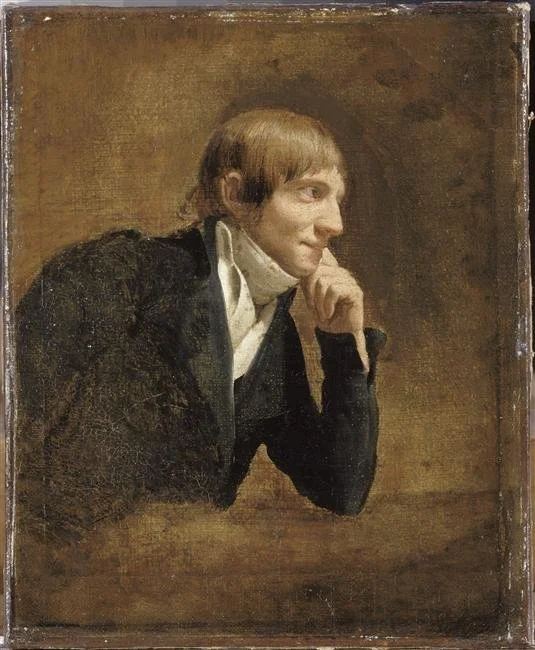
LEFT: Joséphine in coronation costume, 1807-1808, Baron François Gérard, Musée national du Château de Fontainebleau; RIGHT: Portrait of Pierre-Joseph Redouté, c. 1800, Louis-Léopold Boilly, Palais des Beaux-Arts de Lille
Within this climate, botanical illustration reached new heights of refinement. Pierre-Joseph Redouté, who served as a drawing master to Marie Antoinette and later worked under the patronage of Empress Joséphine, produced some of the most famous plant studies of the time. His lavish publication Les Liliacées (1802–1816) depicted lilies, irises, and tulips with remarkable accuracy and delicacy. Many of these specimens were drawn from Joséphine’s garden at the Château de Malmaison, which had become one of Europe’s most ambitious botanical collections, gathering rare species from around the world.
In Les Liliacées, tulips stand isolated against a pale ground, detached from decorative excess. Each stem is carefully observed; each petal is softly modeled with subtle gradations of tone. Unlike the dense Dutch bouquet, the Enlightenment tulip is singular and composed. The focus is on clarity rather than abundance, classification rather than display.
The flower stays beautiful, but its meaning has faded. It echoes a time when people sought order in nature — not through moral stories or market ideas, but through disciplined observation and careful naming.
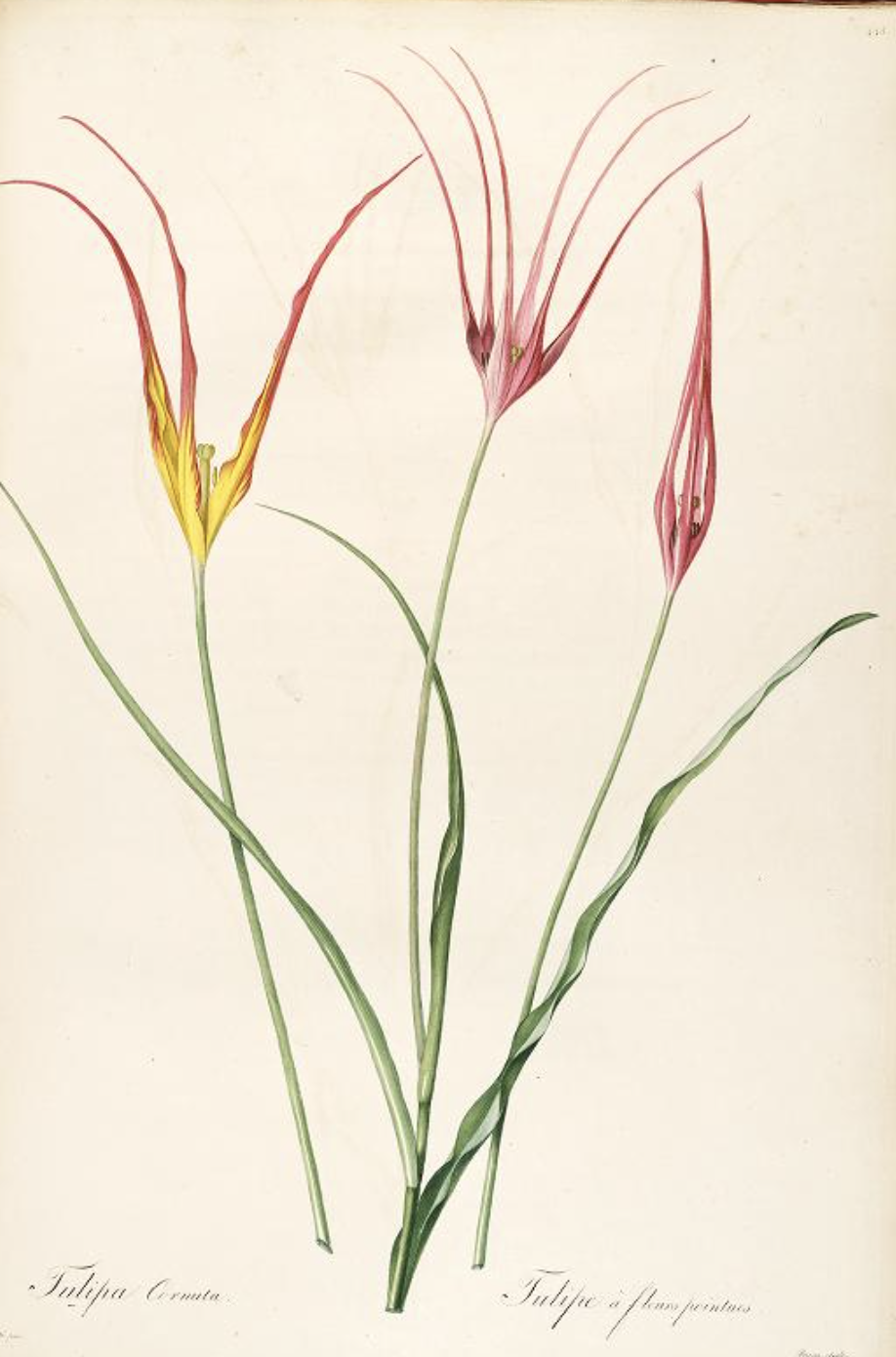
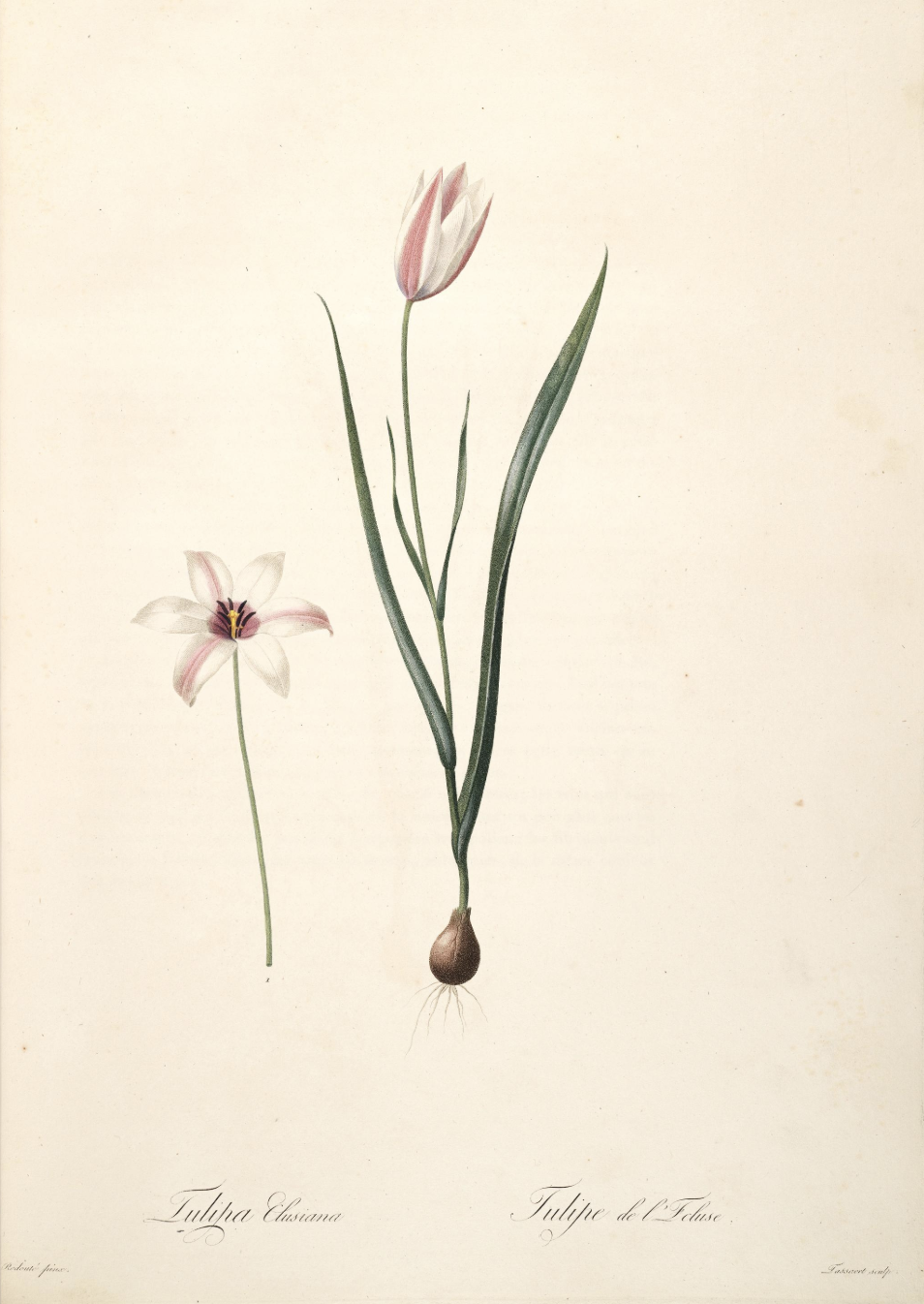
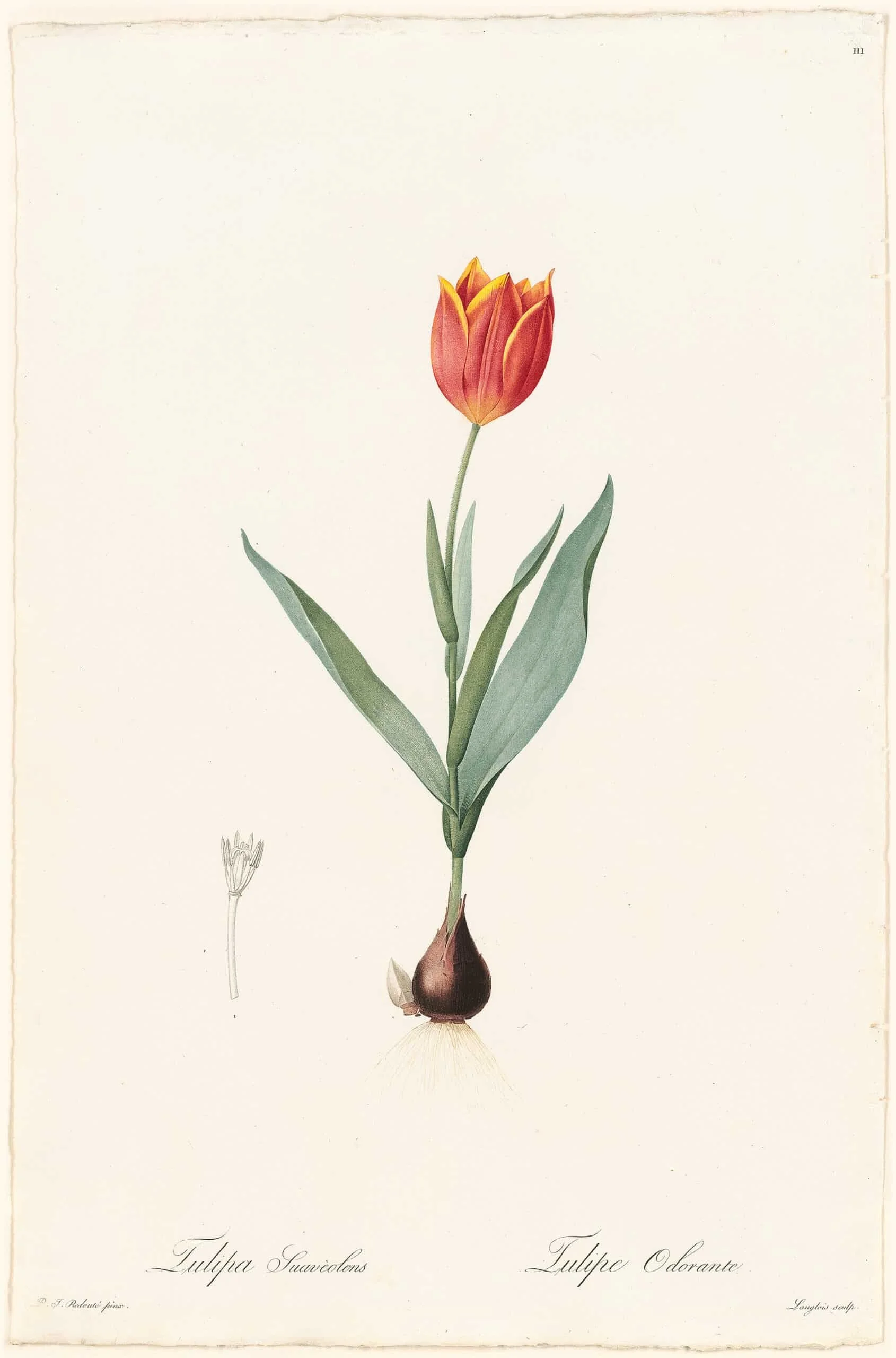
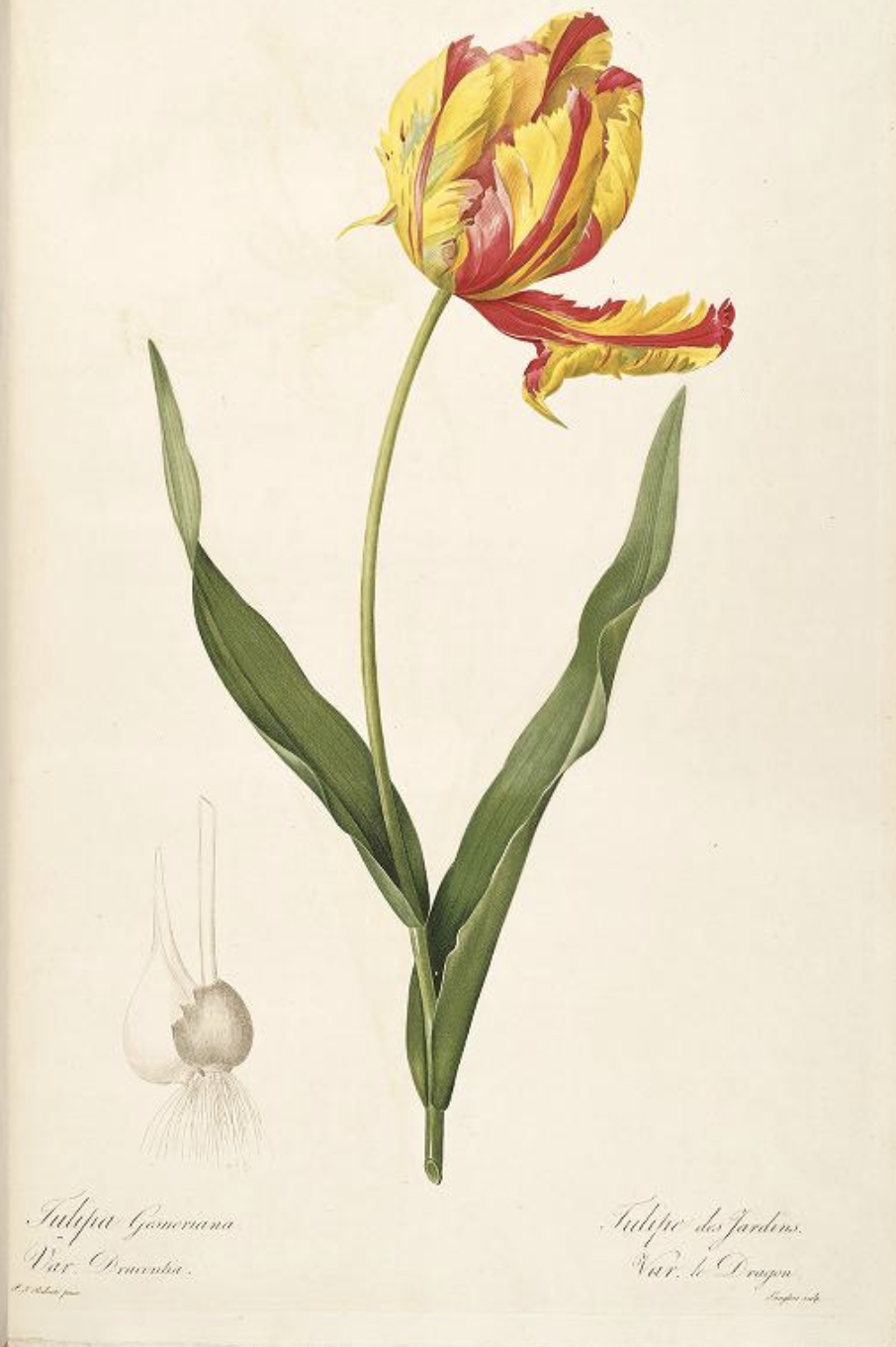
CLOCKWISE: Tulipa cornuta, Tulipa clusiana, Tulipa suaveolens, Tulipa Gesneriana var. Dracontia, Pierre Joseph Redouté, from Les liliacées, 1805 - 1816, Rare Book Division, The New York Public Library
Within this Enlightenment era of botanical investigation, women held a significant institutional role. Before Redouté became prominent, Madeleine Françoise Basseporte served as the official painter to the Jardin du Roi in Paris under Louis XV, taking over from earlier court artists in documenting plants for the royal collection known as Les Vélins du Roi. These works, painted on vellum, were not decorative albums but scientific records. They documented newly cultivated and imported species with precise detail, supporting botanical classification and study. Accuracy was crucial. Form, veining, and structure were clearly rendered so that the image could complement written descriptions.
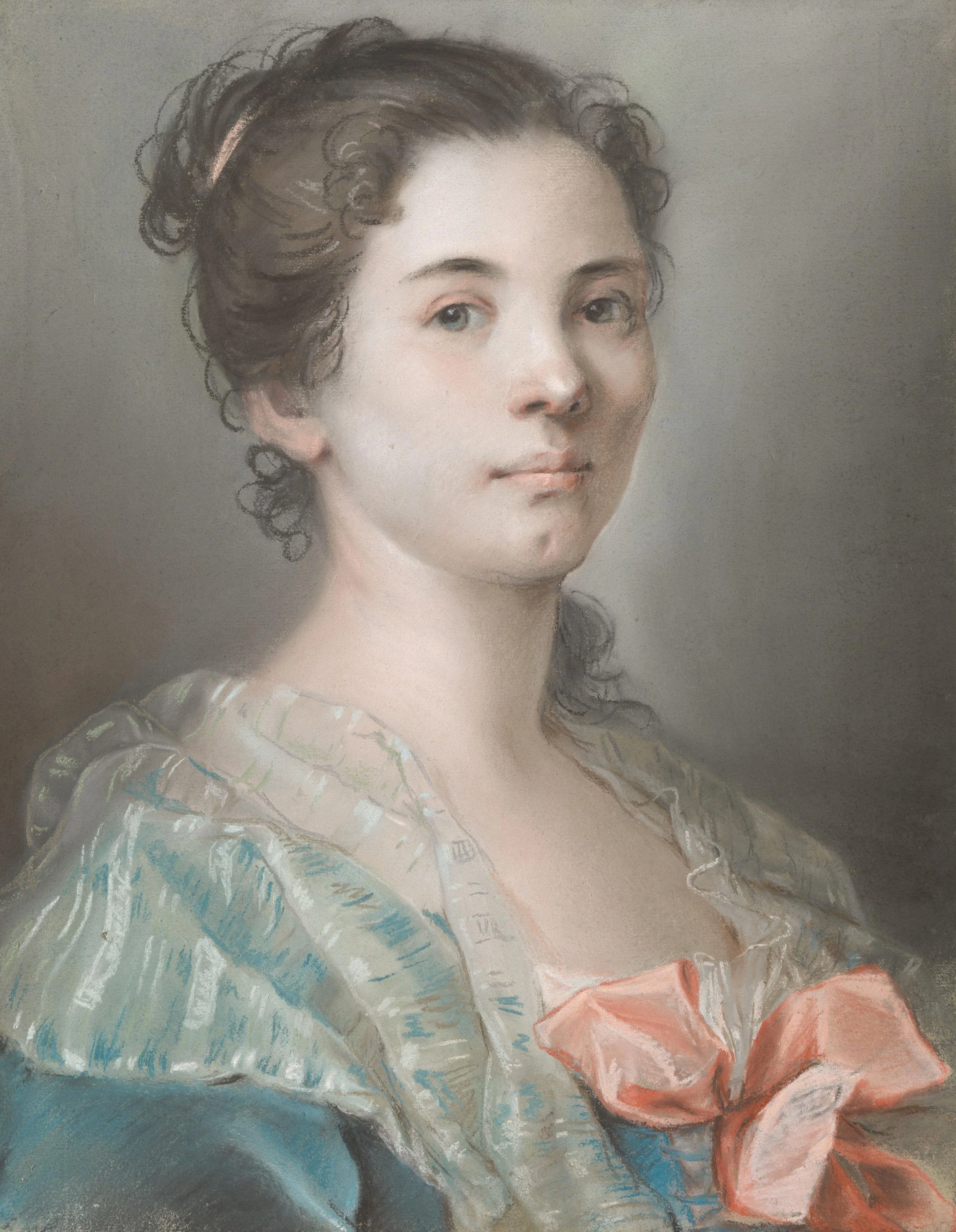
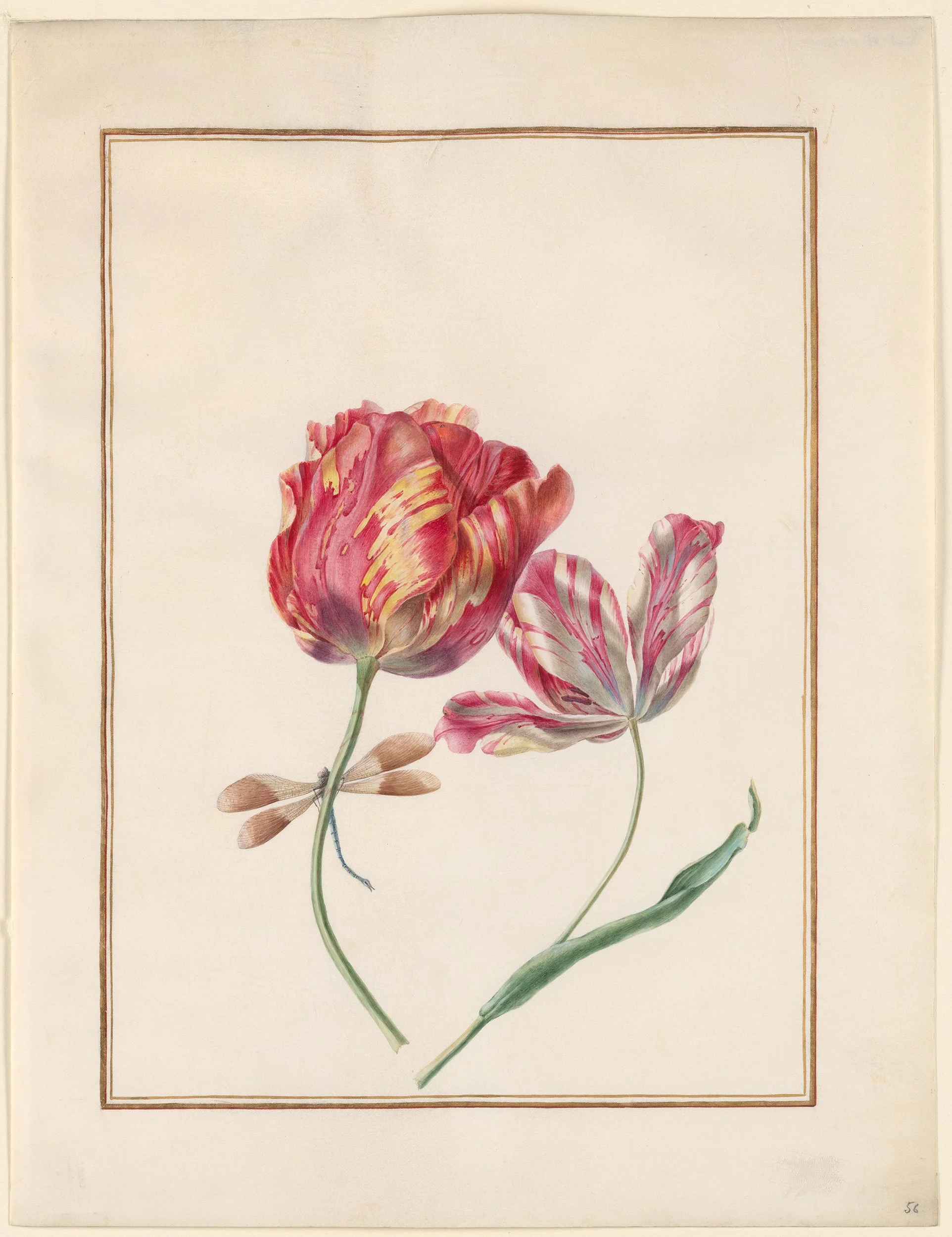
LEFT: Portrait of a Young Woman (likely self-portrait), 1727, Madeleine Françoise Basseporte, Rijksmuseum, Amsterdam; RIGHT: Bizarre Tulips (Tulipa), c. 1750, Madeleine Françoise Basseporte and her circle, watercolor on vellum, The Morgan Library & Museum, New York
In England, Mary Delany discovered her passion for botanical art later in life, beginning her acclaimed paper “mosaicks” in her seventies. Working from living specimens, she cut and layered hundreds of tiny pieces of colored paper to recreate each flower against a dark background. The result is remarkably precise. Although she operated outside formal scientific institutions, her work closely aligned with Enlightenment botanical principles: observation, classification, and a strict adherence to structure. When she depicts the tulip in her series, she treats it neither as ornament nor symbol but as a distinct species to be carefully rendered and understood.
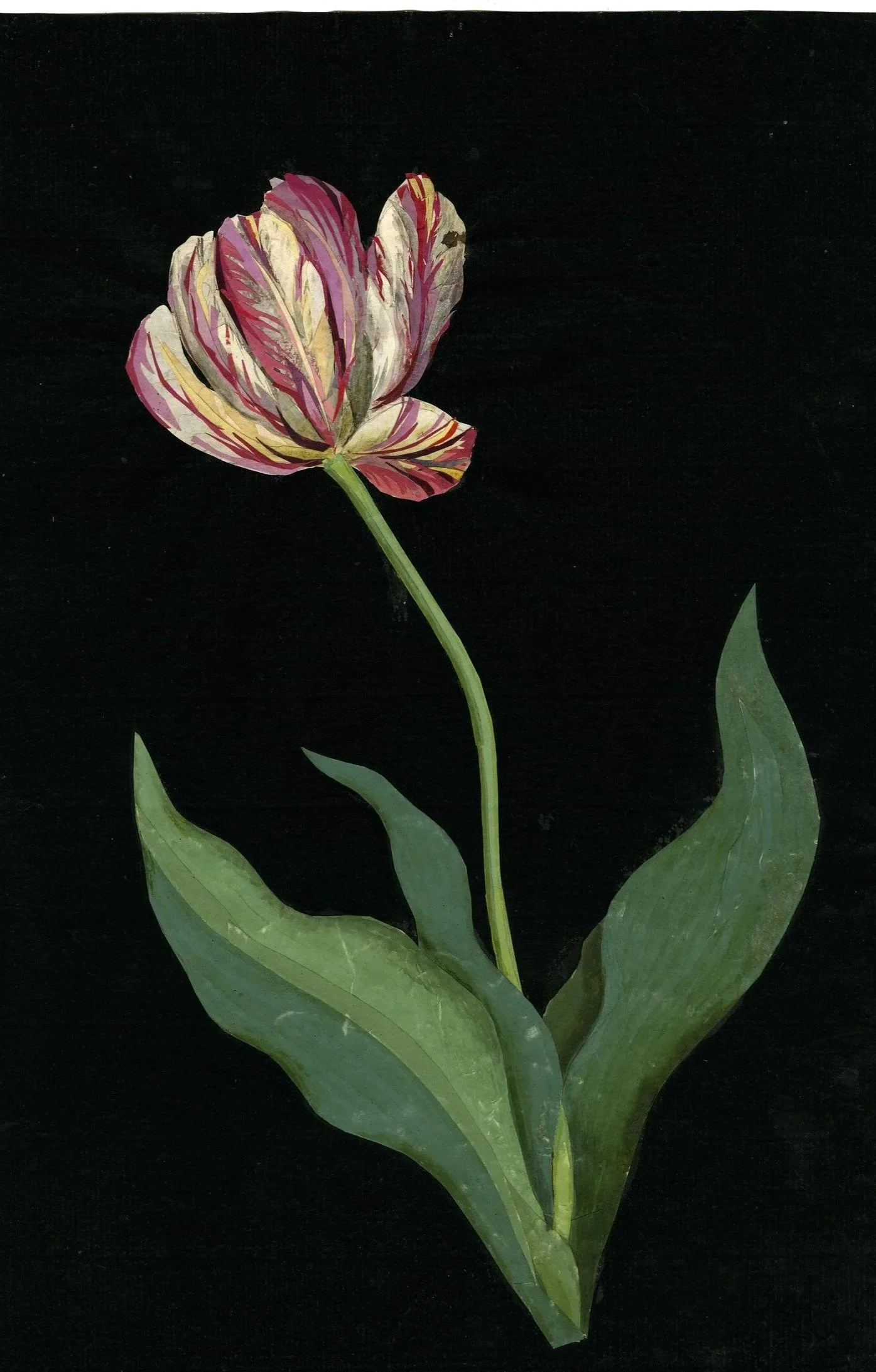
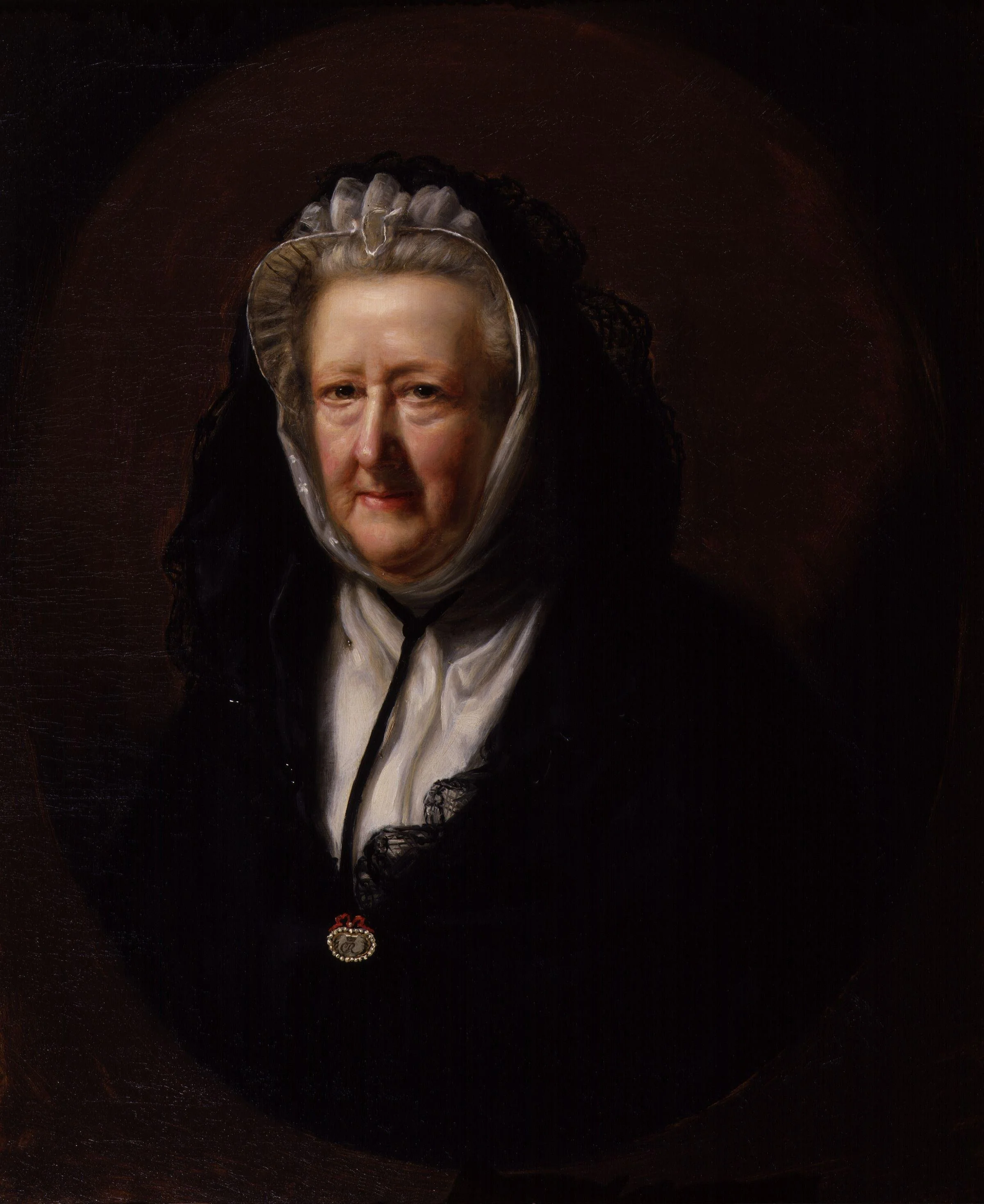
LEFT: Tulipa Sylvestris, from an album (Vol.IX, 65); tulip. 1782 (?), Mary Delaney, © The Trustees of the British Museum; RIGHT: Mary Delany, née Granville, Unknown date, but author died in 1807, John Opie, National Portrait Gallery, London
TULIPS & IMPRESSIONISM: CLAUDE MONET IN HOLLAND
By the late nineteenth century, Europe had transformed. Railways reduced distances. Cities grew larger. Leisure travel became more common. Artists could travel easily between urban areas and rural regions. Industrial advancements introduced brighter synthetic pigments and portable paint in metal tubes, enabling artists to work outdoors for longer periods. Painting was no longer limited to the studio.
Impressionism develops in this setting. Its artists were less focused on creating timeless compositions and more on responding to what they saw—immediately, directly, without smoothing or idealizing the scene. Brushstrokes stay visible. Colors are placed side by side rather than blended. The surface captures the act of looking.
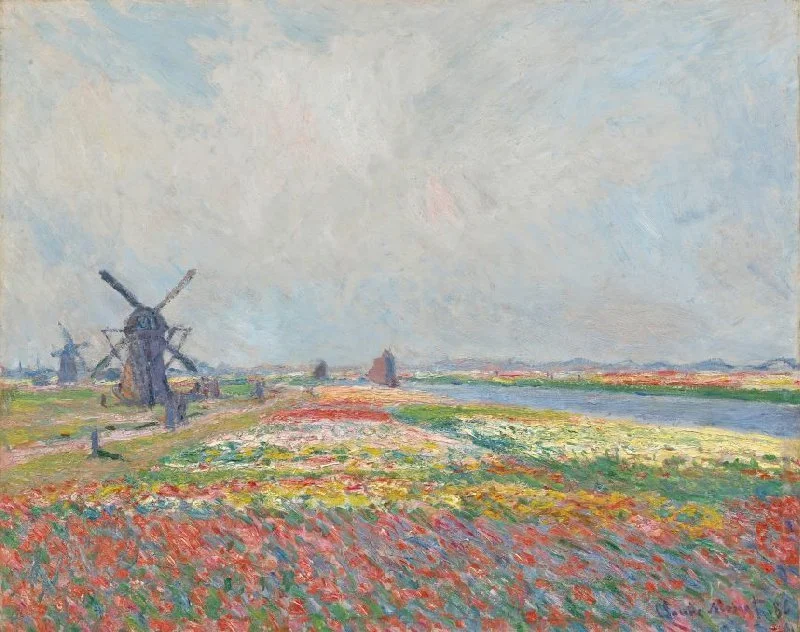
Tulip Fields near The Hague, 1886, Claude Monet, The Van Gogh Museum, Amsterdam. After returning to Paris, Monet sold Tulip Fields near The Hague through the firm Boussod, Valadon & Cie, where Theo van Gogh was employed. It is possible that Vincent van Gogh saw the painting there. Theo had already written to his brother praising Monet’s bold use of color and his rapid, visible brushstrokes.
In the spring of 1886, Claude Monet spent ten days in the Netherlands. He had visited before, but this was the first time he turned his attention to the bulb fields in bloom. What he encountered was not only color, but structure — a landscape defined by radical flatness and by cultivation on a grand scale.
His painting, Tulip Fields near The Hague (1886), is built on that flatness.
The composition divides almost evenly between land and sky, reinforcing the Dutch countryside's horizontal sweep. Across the foreground, the tulip fields form wide, parallel bands of red, violet, and green. The horizon line runs low and steady, interrupted only by a windmill that provides scale and orientation. Without it, the landscape would feel boundless.
Monet was captivated by the intensity of the colors. He wrote that the sight was “impossible to convey with our poor colours.” Rather than attempting a detailed botanical description, he translated the fields into broad strokes and shifting patches of pigment. Individual flowers disappear at this distance. Their presence is conveyed solely through color.
This approach is central to Impressionism. The goal is not botanical accuracy or symbolic layering, but visual immediacy. Red presses against green. Violet breaks against yellow. The effect is not chaos, but optical vibration. The surface feels active and unsettled.
Unlike the tulips that appeared in seventeenth-century Dutch still life — isolated, prized, rendered with meticulous care — these are seen en masse. By the late nineteenth century, bulb cultivation had become an organized agricultural enterprise, its geometry visible from a distance. Monet paints not a single bloom, but a system: land divided, planted, harvested. The tulip is no longer an object of possession. It is a pattern across the terrain.
The windmill quietly anchors the scene in place and tradition. It breaks the horizon, stabilizing the composition, and reminds the viewer that this engineered landscape is deeply tied to Dutch history — wind, water management, and reclaimed land.
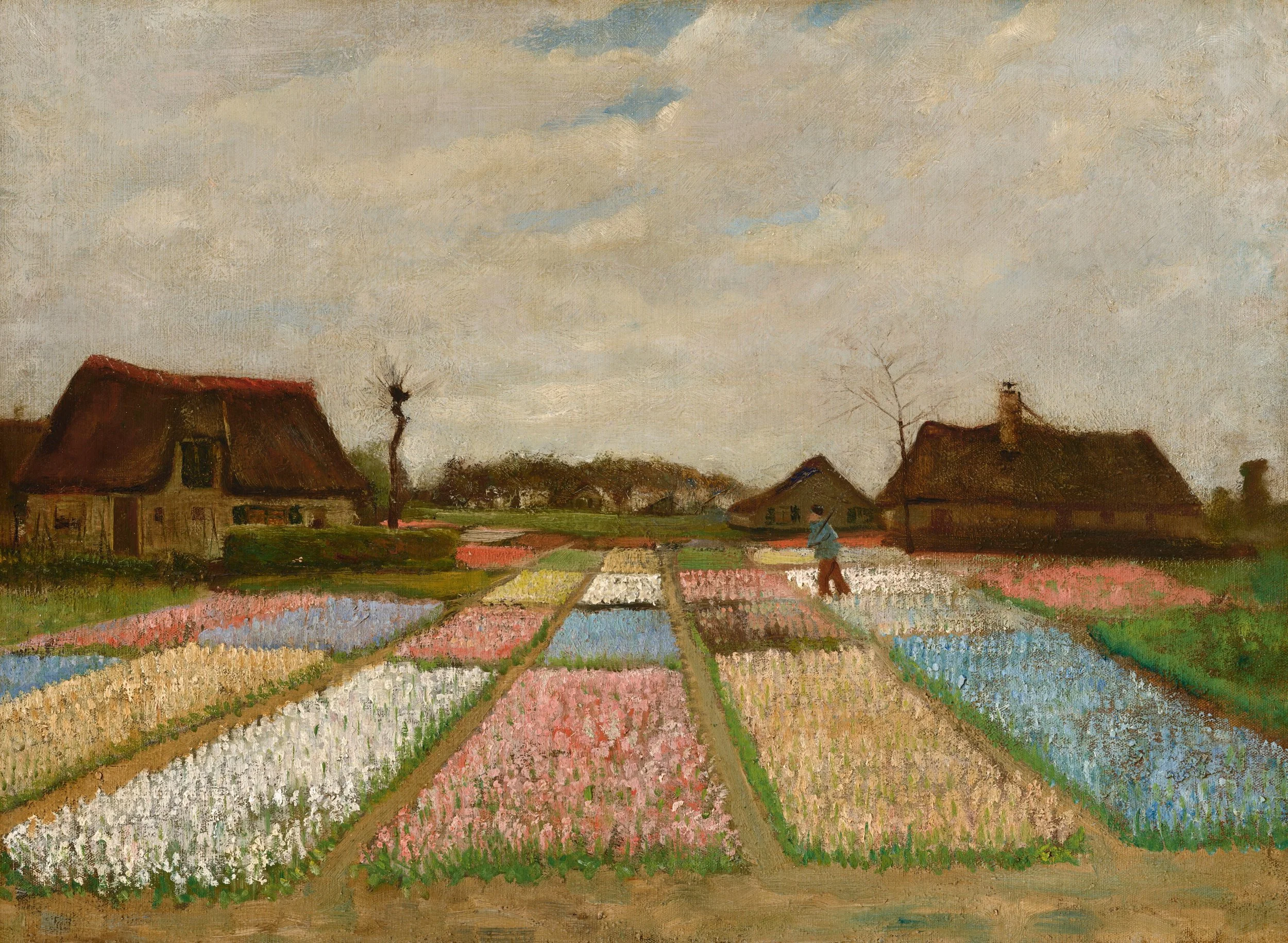
Flower Beds in Holland, 1883, Vincent Van Gogh, National Gallery of Art, Washington, D.C.
Monet was not alone in finding cultivated flower fields compelling. Vincent van Gogh, working only a few years earlier in the Netherlands, painted blooming hyacinth fields in works such as Flowering Bulb Fields (1883). Though the subject is hyacinths rather than tulips, the visual approach is similar. Individual flowers dissolve into bands of color that stretch across the land. The field becomes pattern. Repetition replaces detail.
In both artists’ hands, the bulb field becomes less a botanical study and more an exploration of surface, rhythm, and cultivated geometry. The specific flower matters less than the experience of color laid across space.
TULIPS IN DESIGN: ARTS & CRAFTS, ART NOUVEAU & MODERN ORNAMENT
Even as Impressionist painters dissolved the tulip into fields of color, designers in the late nineteenth century turned back toward ornament. The Arts & Crafts movement, led by figures such as William Morris, sought to resist the anonymity of industrial mass production by reviving handcrafted design rooted in historical pattern traditions. Morris and his contemporaries drew inspiration not only from medieval Europe but also from Islamic and Ottoman decorative arts, whose rhythmic repetition and stylized vegetal forms had long integrated the tulip into architectural and textile design.
In Arts & Crafts textiles and wallpapers, the tulip reappears as a flattened motif. It is no longer a scientific specimen or a landscape subject. It becomes repeatable, rhythmic, woven into dense botanical scrolls. The flower returns to pattern, though now framed as a moral response to industrialization rather than an emblem of empire.
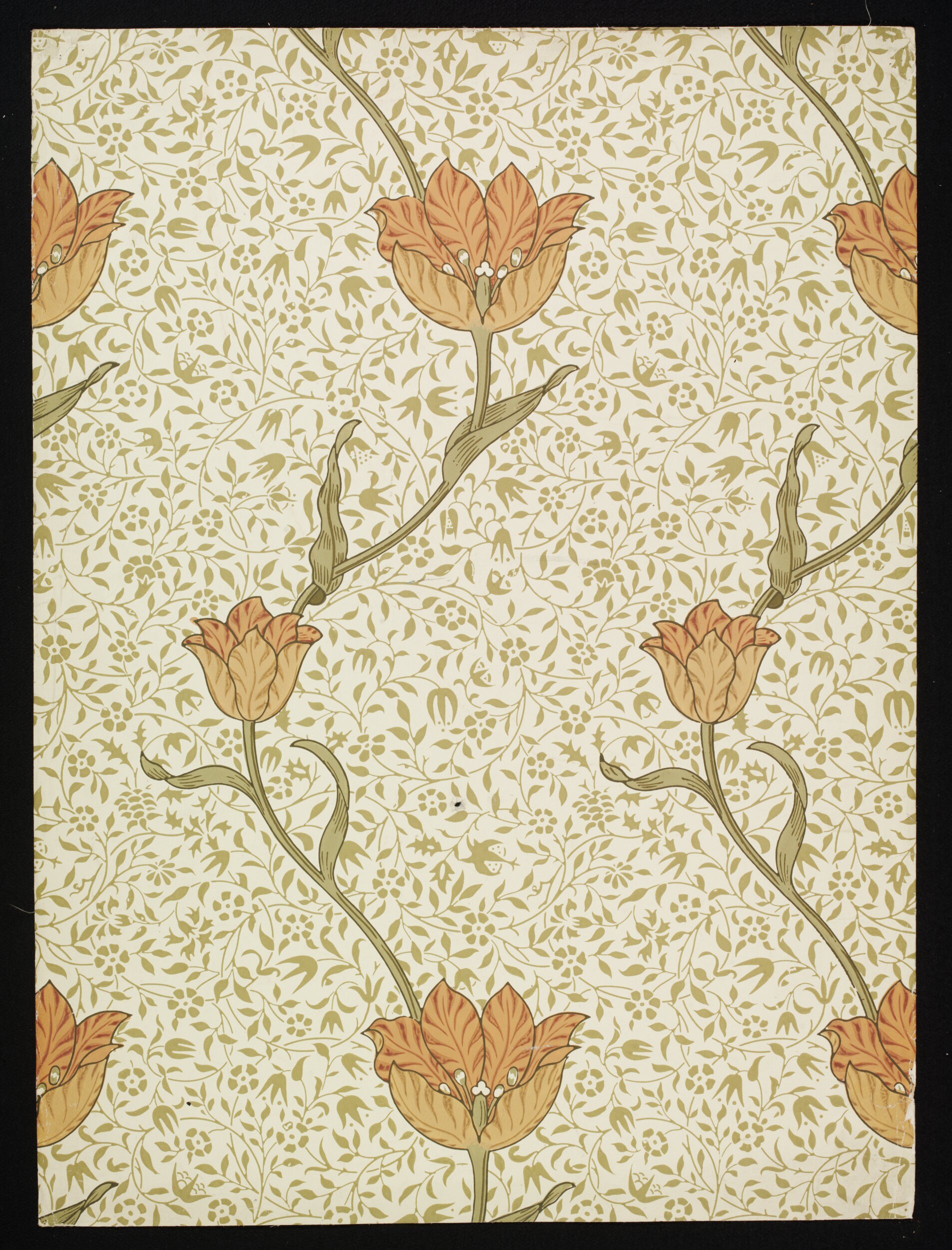
Garden Tulip Wallpaper, 1885 (made), William Morris (designer), © Victoria and Albert Museum, London
At the turn of the twentieth century, Art Nouveau further stylized the flower. Designers embraced elongated stems, sinuous curves, and organic line. In glass and decorative arts — particularly in the lamps and stained-glass designs of Louis Comfort Tiffany — tulip-like forms appear in glowing, layered color. Petals become sculptural arcs of glass; stems bend into elegant silhouettes. Nature is not copied but transformed into a flowing ornament.
By the time Art Deco emerged in the 1920s, floral forms grew more abstract and geometric. The tulip is pared down even further. Its petals sharpen into geometric arcs; its silhouette becomes symmetrical and architectural. In the glasswork of René Lalique or the marquetry of Émile-Jacques Ruhlmann, the flower is no longer observed in nature. It is engineered into ornament.
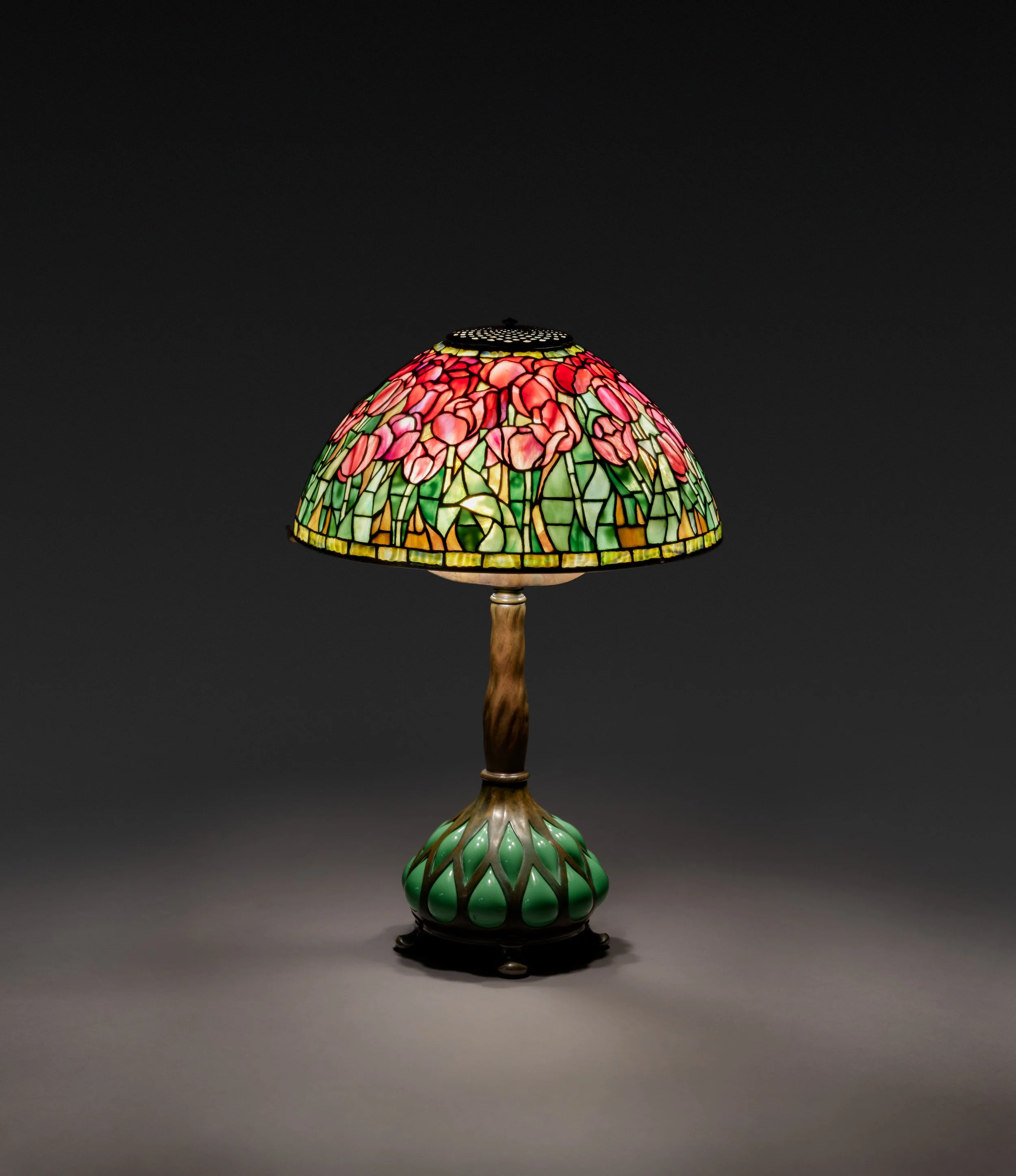
Tulip Table Lamp, c. 1900–1906, Tiffany Glass & Decorating Company, The Cleveland Art Museum
𐫱
Across centuries, the tulip has moved through radically different visual systems. In the Ottoman Empire, it functioned as a disciplined imperial motif. In early European prints, it appeared as a specimen to be recorded. In Dutch still life, it rose from the vase as a marker of rarity, often prized for dramatic “broken” patterns caused by a virus that made the flower both unstable and desirable. Under the Enlightenment, it stood isolated and named. By the time Monet encountered it, industrial agriculture had transformed tulips into vast cultivated fields, standardized and multiplied across reclaimed land. Designers of the Arts & Crafts movement and Art Nouveau would later reclaim the flower once more, flattening and stylizing it into pattern as a response to industrial modernity.
The tulip did not remain fixed. It was bred, infected, stabilized, and industrially reproduced. Yet at every stage, artists framed it according to the intellectual and cultural priorities of their moment. Its history in art reveals not only changing ideas about beauty, but evolving systems of power, knowledge, ownership, and perception. The tulip is never just a flower; it is a record of how societies choose to see.
RECOMMENDED READING
ISLAMIC WORLD
The Ottomans: A Cultural Legacy by Diana Darke
Iznik: The Artistry of Ottoman Ceramics by Walter B. Denny
BOTANICAL ILLUSTRATION
Basilius Besler. Florilegium. The Book of Plants (TASCHEN)
Basilius Besler. The Garden at Eichstätt (TASCHEN)
Flora Illustrata: Great Works from the LuEsther T. Mertz Library of The New York Botanical Garden, edited by Susan M. Fraser and Vanessa Bezemer Sellers
A Garden Eden. Masterpieces of Botanical Illustration (TASCHEN) by Walter Lack
A Natural History of English Gardening: 1650–1800 by Mark Laird
Mrs. Delany: A Life by Clarissa Campbell Orr
Redouté, The Book of Flowers (TASCHEN)
Redouté. Roses (TASCHEN)
FLORAL STILL LIFE
Forever Flowers: Mastery and Meaning of Flower Paintings in the Low Countries (1600-1700) by Sven Van Dorst
Jan Davidsz. de Heem by Fred G. Meijer
Rachel Ruysch: Nature Into Art
IMPRESSIONISM
Monet. the Triumph of Impressionism by Daniel Wildenstein
ARTS & CRAFTS
Tulips and Peacocks: William Morris and Art from the Islamic World by Rowan Bain
V&A Pattern: William Morris by Linda Parry
William Morris's Flowers (V&A Museum) by Rowan Bain
William Morris: Pattern & Design (V&A Museum) by Jenny Lister