Miami Beach's Historic Art Deco Architecture: A Guide
Updated March 28, 2026
In the mid-20th century, Miami Beach was a glamorous seaside resort, famous for its stylish hotels, vibrant nightlife, and steady influx of visitors.
By the 1970s, that image had diminished. Tourism dropped after the 1971 opening of Walt Disney World in Orlando, which attracted many vacationers away. Crime increased, and many hotels began catering to middle- and lower-income retirees, while wealthier residents moved north to more upscale parts of South Florida.
A phrase popular at the time summed up the mood: “Miami Beach is where neon goes to die.”
Still, the city’s story did not end there.

The iconic Carlyle Hotel, Miami Beach, opened in 1939. As a historic landmark, not even the font of the neon sign can be altered. Neon signage is a classic design element of Miami Art Deco, used on exteriors and interiors. Photo by author.
By the late 1980s and into the 1990s, Miami Beach started changing again. Artists, designers, and celebrities were attracted to its faded glamour and unique architecture, bringing fresh energy to the area. Figures like Madonna, Prince, and Gianni Versace helped rebuild the Beach as a cultural hotspot.
Versace’s murder in 1997 on the steps of his Ocean Drive residence marked a tragic and widely publicized moment in the city’s revival. But the larger transformation kept going.
Today, Miami Beach is known as much for its cultural events, such as Art Basel Miami Beach and the South Beach Wine & Food Festival, as for the architecture that helped shape its identity.

Miami Beach in the early 90s. Photo by British photographer and film director, Barry Lewis who started to document Miami Beach in South Florida in the late 80s, regularly flying out from London to capture portraits and street scenes.
A City Built in Art Deco
Miami Beach is home to one of the largest concentrations of Art Deco architecture worldwide. The South Beach historic district features over 800 buildings built between 1923 and 1943.
Despite a devastating hurricane in 1926 and the financial difficulties of the Great Depression, development persisted. Hotels and apartment buildings sprang up along the coast in the then-popular Art Deco style.
Much of Miami Beach’s building boom came during the later phase of Art Deco, known as Streamline Moderne. Compared to earlier Art Deco, it was simpler and more subdued—reflecting the economic challenges of the Depression—while still embracing modernity, speed, and industrial design. Sleek curves, horizontal lines, and nautical motifs expressed optimism and progress, mirroring the energy of 1930s World’s Fairs.

The Essex House Hotel, completed in 1938 by famed Floridian architect, Henry Hohauser. Note the “eyebrows” above the window. Photo by author.
Two architects played a significant role in shaping this landscape: Henry Hohauser and L. Murray Dixon, responsible for about 70% of the district’s buildings. Their designs were deliberately budget-friendly and less ornate than those of grand urban landmarks like the Waldorf Astoria, making them accessible to an expanding middle-class tourist market.
Miami Beach’s Art Deco buildings share a distinctive visual style. Many resemble ocean liners, with rounded facades, horizontal lines, and porthole windows—subtle references to the city’s seaside identity. Others highlight symmetry, bold vertical lines, and geometric patterns, all characteristic of the broader Art Deco movement.
Tropical Deco: A Local Adaptation
What distinguishes Miami Beach is not just the quantity of Art Deco buildings, but how the style was adapted.
Architects responded directly to the realities of a tropical, coastal climate—heat, humidity, glare, and the need for airflow—while still working within the language of Art Deco.
Before air conditioning became widespread, buildings had to stay cool naturally. Features like the “eyebrow”—a projecting ledge above windows—helped shade interiors from the intense Florida sun. Deep-set windows and light-colored façades reduced heat absorption, while operable windows and narrow floor plans encouraged cross-ventilation, allowing ocean breezes to move through interiors.
Materials were also chosen with the environment in mind. Terrazzo floors, stucco exteriors, and smooth, durable surfaces held up well against humidity and salt air, while remaining easy to maintain. Rounded corners and streamlined forms—hallmarks of the style—also helped deflect strong coastal winds.
At the same time, architects incorporated local imagery and visual identity, creating what is now called Tropical Deco. Buildings feature playful reliefs of flora and fauna, pastel color palettes, and references to ocean liners—reinforcing Miami Beach’s identity as a seaside resort.
Originally, most buildings were painted white with subtle pastel accents, allowing the architecture to stand out in the bright coastal light. The now-iconic palette of candy colors came later, in the 1980s, when designer Leonard Horowitz introduced a coordinated range of hues to highlight architectural details and revive the district’s visual appeal.
Coral also played a role in shaping the look and feel of these buildings. Used in façades and interiors, it added texture and reinforced the connection to the surrounding coastline. Today, coral mining is banned, making these details a lasting record of an earlier approach to construction.
The result is a style that is both modern and regional: Art Deco, reshaped by climate, light, and place.
Saved from Demolition
By the 1970s, many of these buildings were at risk. Large-scale redevelopment plans threatened to erase much of Miami Beach’s architectural identity by replacing low-rise Art Deco structures with high-rise towers.
Preservation efforts, led by Barbara Baer Capitman, changed that trajectory. In 1976, she co-founded the Miami Design Preservation League and launched a campaign to protect the district. Through protests, advocacy, and persistent lobbying, Capitman and her supporters stopped widespread demolitions—sometimes literally standing in front of bulldozers. Although some buildings were lost, many were saved, and in 1979, the Miami Beach Art Deco District was added to the National Register of Historic Places.
Today, what remains shows a hard-fought recognition of a style that was often dismissed at the time.

When the Loews Miami Beach Hotel first opened in 1998, it bucked an of-the-moment trend by becoming the first new hotel to be built in Miami Beach in more than 30 years. Yet they didn't start completely from scratch: a 17-story tower was built around the St. Moritz, a 1939 Art Deco gem, to create a new hotel with history. Note the new tower with its classic Art Deco needle.

Miami Beach Police Department, while constructed more recently, is shaped like a ship in classic Art Deco style. Photo by author.

Portholes! Photo by author.

Hotel Victor. This storied Art Deco boutique hotel on Ocean Drive built in 1937 and designed by architect L. Murray Dixon.

The local post office in the style of “Deco-Federal,” and also known as “Stripped Classic” or “Depression Moderne.” It has a classical central rotunda and a minimalist façade, but the interior is busy with a cowboys-and-Indians frieze, a starburst ceiling and bits of shiny brass detailing. Photo by author.
And, my goodness, all the coral.
Luxurious finishes and materials are classic elements of Art Deco design, and Miami Beach architects mined the ocean to clad entire facades and hotel lobbies. The use of coral was also a nod to the unique quality of Miami Art Deco—Tropical Deco. Some buildings incorporate raw and rough coral, while others have dyed and polished coral finishes.
Fortunately, mining coral has now been banned.

The Tudor House, built in 1930. Note the pink, polished coral facade detail and the needle tower. The Tudor House has one of the best rooftop pools and bar on Ocean Drive.
What to Notice While Walking
Walking through South Beach today, certain details begin to repeat and define the district:
Symmetry
Stepped (ziggurat) rooflines
Glass block
Decorative sculptural panels
“Eyebrows” above windows
Round porthole windows
Terrazzo floors
Curved edges and corners
Design elements in groups of three
Neon lighting, both exterior and interior
One contemporary addition worth noting is the Betsy Orb, a sculptural skybridge connecting two historic hotels—The Betsy (1941, by L. Murray Dixon) and The Carlton (1937, by Henry Hohauser)—serving as both a functional link and a tribute to the architects who shaped the district.
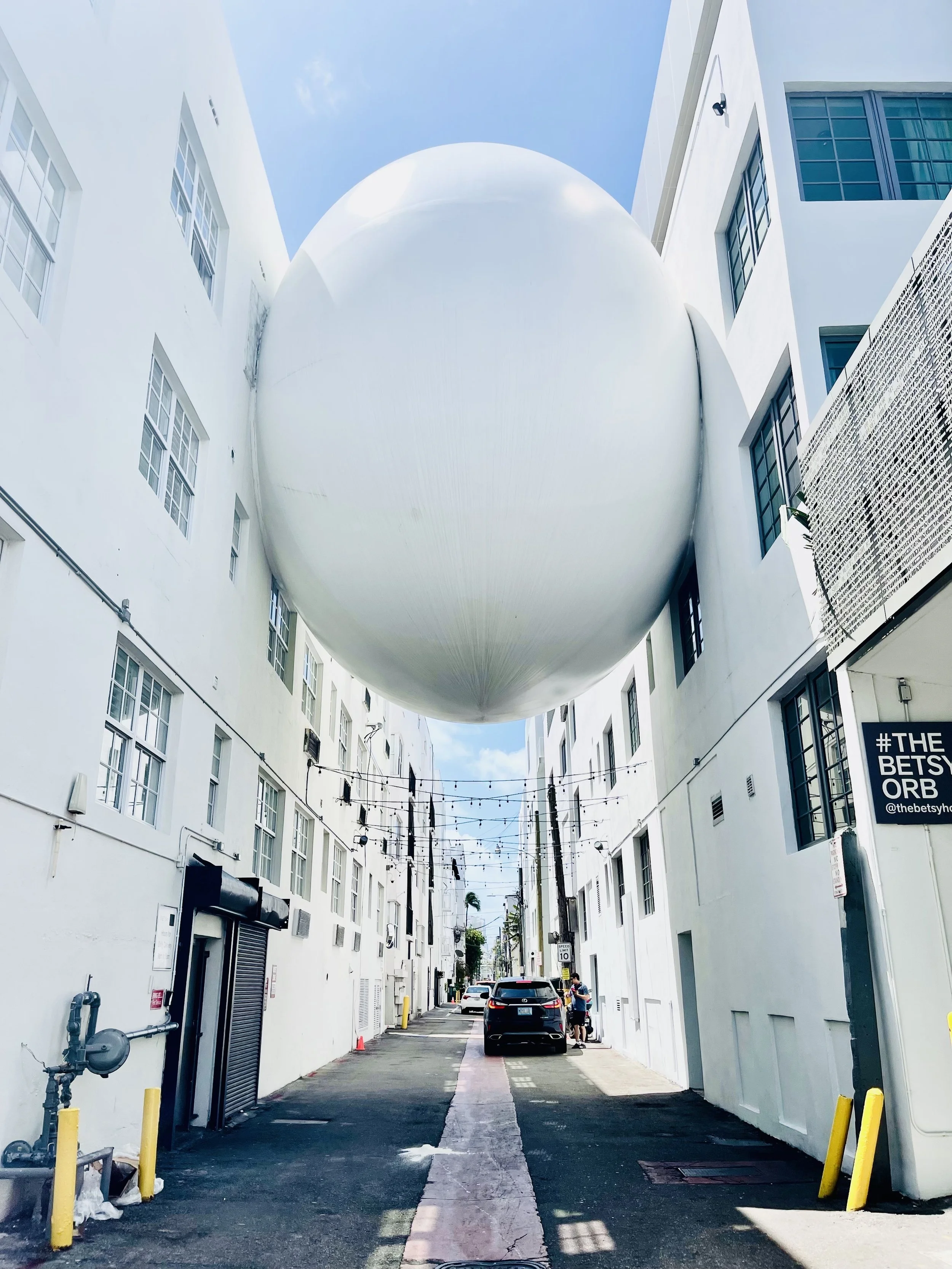
Officially known as "The Betsy Orb," this egg-shaped, third-floor sky bridge (and public work of art) connects two architecturally significant hotels: The Betsy (designed by L. Murray Dixon, built in 1941) and The Carlton (designed by Henry Hohauser, built in 1937 ). Photo by author.