Water lily or Sunburst? Key Differences Between Art Nouveau and Art Deco
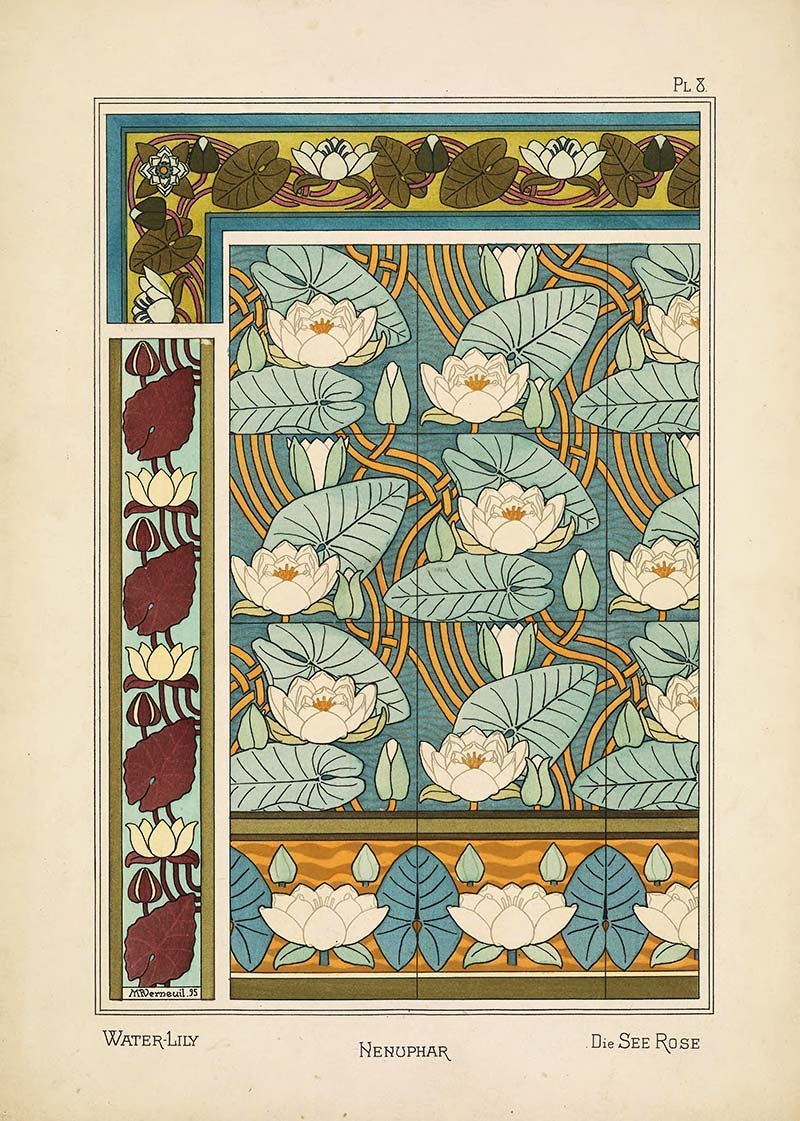
Water lily flower print by French artist, Maurice Pillard Verneuil (1869-1942). Image source: Picture Box Blue
Art Nouveau and Art Deco are two of the most popular and defining decorative design styles of the modern era.
Both movements emerged in the early 20th century and have influenced the development of art in a wide range of fields, including fashion, jewelry, graphic design, architecture, and interior design.
Each was also a reaction to major world events. Art Nouveau, lasting roughly from 1880-1914, was a result of the Industrial Revolution, while Art Deco was a result of WWI and encompassed the 1920s and 30's, the period between the wars. These reactionary, modernist art movements also tend to look similar.
While Art Deco and Art Nouveau both contain modernist elements, they are markedly different visually.
So, what exactly is the difference between these two iconic styles?
Art Nouveau
Art Nouveau is an ornamental style of art originating in late 19th-century Belgium and developed by architects and designers such as Victor Horta, Henry van de Velde, and Paul Hankar. The movement then spread throughout Europe, Britain, and America. It started to fade out in 1915, but elements of Art Nouveau remained in use into the 1940s, especially in France.
Translated as 'new art' in French, Art Nouveau is often considered the first modern design style. The style embraced Europe's new industrial aesthetic rather than challenging it. In the late 19th century, the Industrial Revolution had advanced to the point where craftsmen and designers could produce mass-produced works, leading to this “new art.” It featured industrial materials and methods but applied them in a highly stylized manner, as in the metalwork of the Eiffel Tower.
Unlike earlier movements, which had been concerned with reviving historical styles, Art Nouveau artists sought to create a new style that would be uniquely modern. Many designers drew inspiration from nature, creating organic forms inspired by plants and animals. It is characterized as a dynamic, swirling, curling, and flowing style that uses irregular and asymmetrical lines, highlighted by natural motifs (leaves, flowers, animals, etc). "Laurel leaves and thorny vines twine around stylized flowers, insects, and mythical creatures," according to the Norton Simon Museum of Art. Examples of the style include the paintings of Gustav Klimt, Lalique jewelry, and Tiffany lamps.
While Art Nouveau is often richly colored and quite detailed, it uses many earth tones, muted colors, and pastels. These qualities, combined with the flowing design, give it a softer, more abstract appearance than Art Deco.
Art Deco
Art Deco first appeared in France when Paris hosted the 1900 World's Fair. It flourished in the 1920s and 30s after the deprivations of the Great War years gave way to a whole new opulence and extravagance associated with the Roaring 20s and Jazz Age in the United States and Europe.
The style reflects the optimism and technological developments of the time and eschews traditional Victorian architectural styles, such as Beaux-Arts, Gothic, and Renaissance Revival. While it faded with the onset of the Great Depression and WWII, Art Deco returned to popularity in the 1950s, when its clean lines and simple shapes appealed to an emerging middle class.
Unlike Art Nouveau, Art Deco relies more on geometric shapes and straight lines inspired by Cubism, a modern art movement that emerged in France during the first decade of the 20th century. It is also heavily influenced by bold colors and sharp geometric patterns, as seen in African and Oceanic art. The style has a hardness that makes it seem strong and powerful. This gives it a more modern look than the more fluid, flowery look of Art Nouveau, and it still looks modern today.
Art Deco is more simplistic in both color and detail than Art Nouveau. The primary colors of the Art Deco movement are black, white, and silver, as compared to the pink and green pastels associated with Art Nouveau. Along with these bold, darker colors, Art Deco also featured vibrant, brighter colors such as red, blue, and yellow.
Art Deco's geometric forms and streamlined shapes are actually a reaction against the decadence and elaborate ornamentation of Art Nouveau. In fact, much Art Deco work tends to have a machine-inspired quality. Think zigzags, chevrons, and strong, straight diagonals.
Art Deco was often used in the design of buildings, often characterized by a large base of rectangular shapes with a smaller section on top. In fact, the style was once considered a standard for skyscrapers and is the look of some of the most well-known buildings in the United States, like the Chrysler Building, the Empire State Building, and the Chicago Board of Trade Building. In the United States during the 1930s and 1940s, the WPA Project used Art Deco styles in the design of public buildings and monuments.
Overall, Art Deco is a strong, bold look without any hint of softness or romance of Art Nouveau, and was a more practical form of art than Art Nouveau.
* * *
Despite their differences, Art Deco and Art Nouveau are closely linked by the fact that they both originated in Europe around the same time. Throughout the years, many architects and designers have combined elements of Art Nouveau and Art Deco to create unique and innovative designs. This happened during the 1960s and 1970s (the Modernist Movement), and it continues to this day.
So, to answer the question: Lily pad or Sunburst?
A lily pad is a natural element and, therefore, typical of Art Nouveau. Take another look at the title image of this post and note how the water lily is painted with the classic muted colors of the art movement. Colors such as muted greens, white, mustard, and pale peacock blues.
The sunburst, with its radiating lines and angles, was a classic Deco motif - from the inlay of a console table to the crown of the Chrysler building.

View of Chrysler Building from Empire State of Building with view of city behind it. Image source: LazarNikolic via Shutterstock