Let Them Eat Macarons! The Sweet History of a French Cookie
Updated: December 4, 2025
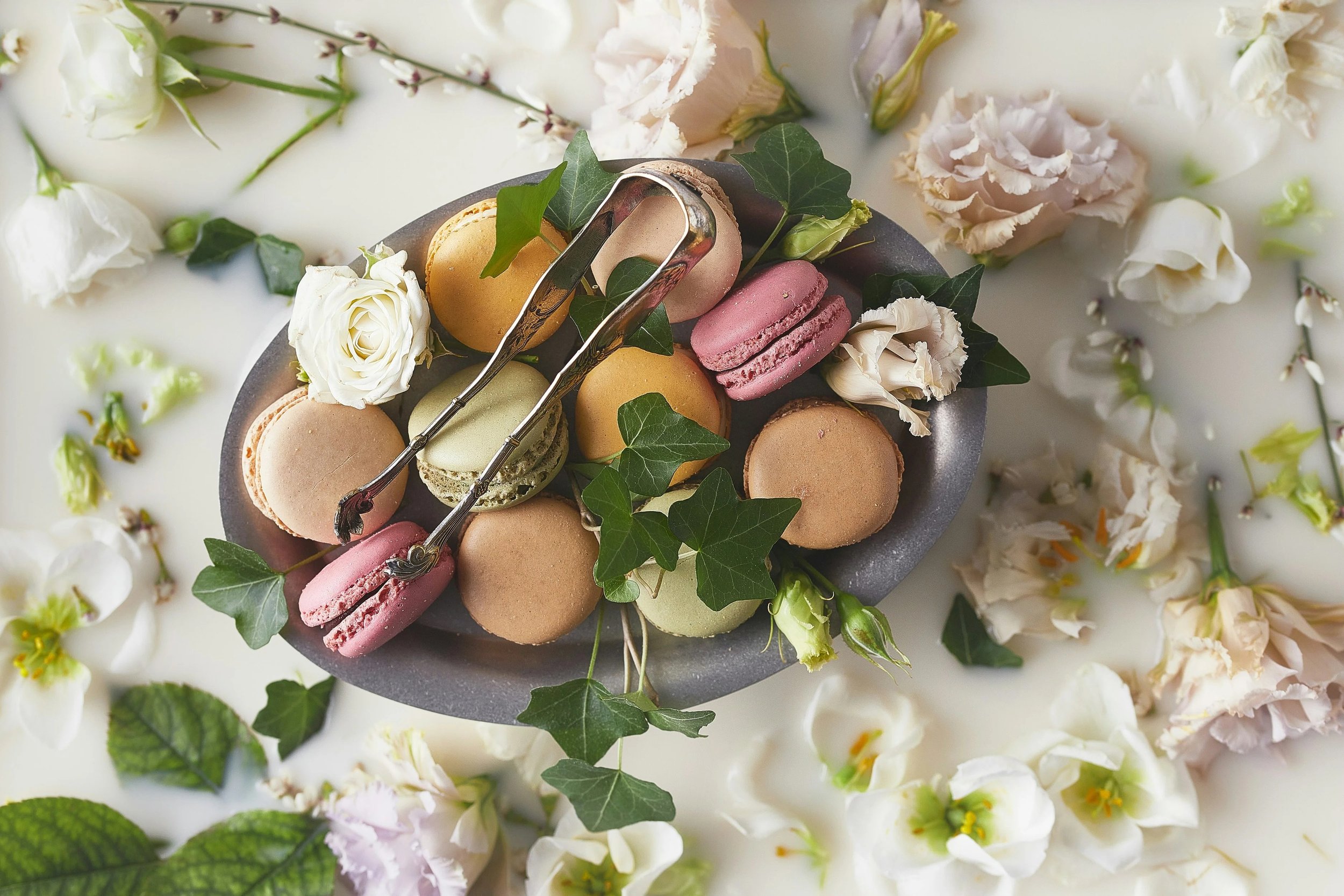
Image Credit: Olivie Strauss via Unsplash+
LE MACARON À LA MODE.
Parisian macarons are everywhere.
This classic French cookie — a delicate meringue-based confection made with egg white, sugar, almond meal, and a little food coloring — appears just as often in upscale patisseries as it does on the shelves of Trader Joe’s.
They’ve become an ideal gift and a deliciously decadent craze that now has its own international holiday.
Oui, c’est vrai.
Mark your calendars: March 20 is Macaron Day, celebrated around the world.
The tradition began in 2005 when Parisian pastry shops started offering free macarons and donating a portion of their proceeds to charity. The idea soon spread to New York City, and today, dozens of cities participate each year.
Yet for all their popularity, the history of this little treat is often misunderstood — and its recipe is still confused with another dessert entirely: the macaroon, with two o's.
To clear things up, let’s first turn to Hollywood.
A STAR IS BORN.
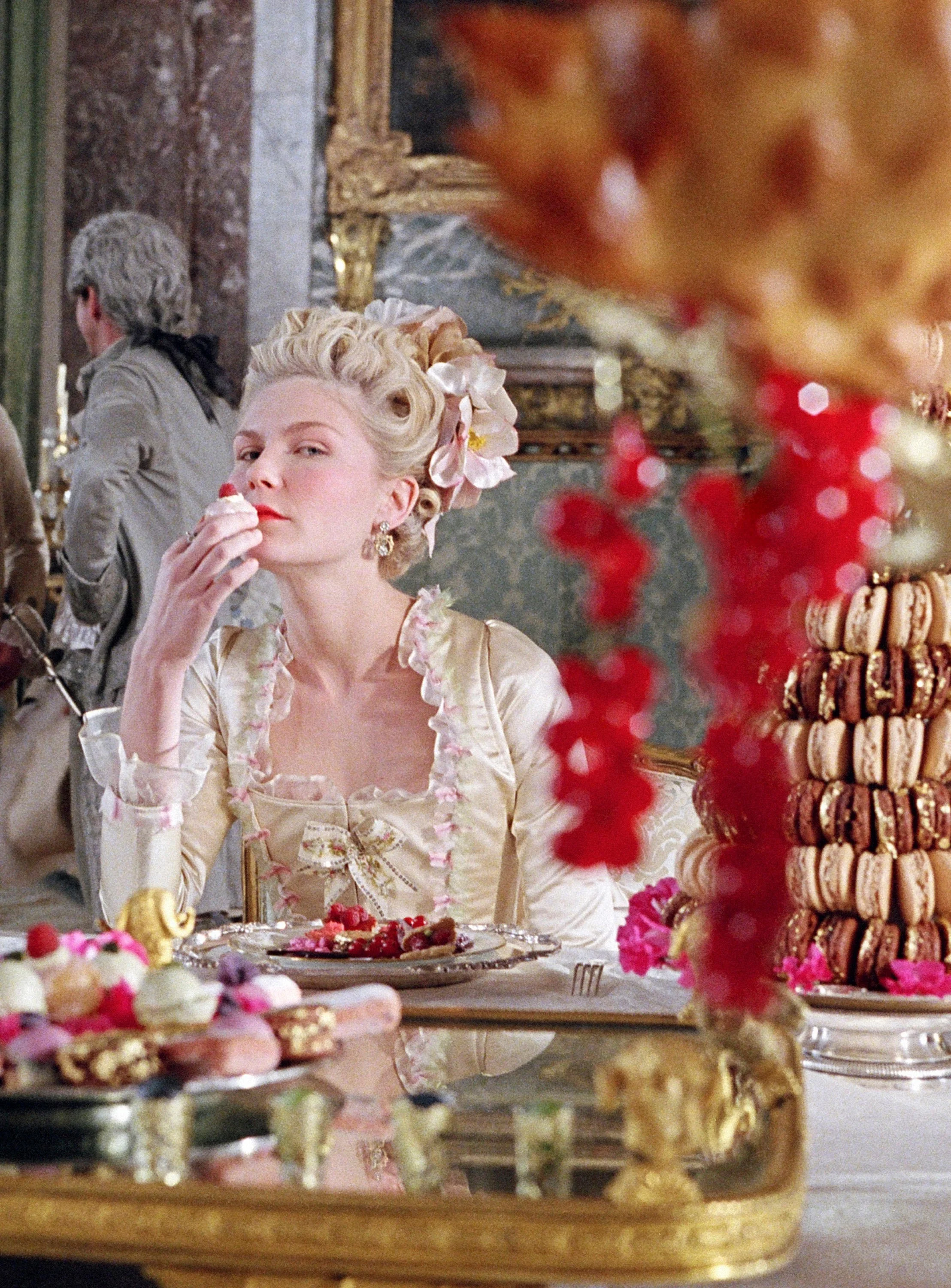
Film Still Kirsten Dunst from Sofia Coppola’s "Marie Antoinette." Image Source:
PictureLux / The Hollywood Archive via Alamy
Macarons are arguably the most photogenic food on earth. The bright colors, the perfectly symmetrical shape, the delicate appearance. They are a feast for the eyes and the taste buds alike.
Quite fittingly, then, they were the backdrop to Sofia Coppola’s sumptuous 2006 film, Marie Antoinette, starring Kirsten Dunst. In the movie, Marie Antoinette is often pictured surrounded by sweets of all sorts, including macarons — in the rose tones we’ve come to associate with the doomed queen who supposedly once said, “Let them eat cake” to her starving peasant subjects.
Indeed, Coppola partnered with the famed Parisian patisserie and tea shop, Ladurée, to provide macarons for the movie. Laudrée is credited with inventing the Macaron Parisien, and Coppola reportedly handed her costume designer a box of pastel-colored Ladurée macarons, saying, “These are the colors I love,” thereby inspiring the film's palette.
According to Elisabeth Holder Raberin, owner of Ladurée, her chic patisserie is “forever linked” with Marie Antoinette and the Palace at Versailles.
“Le Petit Trianon . . . is so Marie Antoinette and feminine. She had her garden, flowers, milk, fresh produce: the ingredients for Ladurée quality today.”
A macaron star was born.
Except that Marie Antoinette and macarons were never actually linked.
Just as it’s now widely understood that Marie Antoinette never uttered the words “Let them eat cake,” it’s also a myth that she ever tasted the Parisian macaron we know today.
Ladurée did popularize the modern macaron, yes, but Louis Ernest Ladurée opened his Parisian tea room in 1862. And it wasn’t until the 1930s, nearly 150 years after Marie Antoinette’s death, that his grandson Pierre Desfontaines paired two macaron shells with a creamy filling and, voilà, created the sandwich version familiar today.
Marie Antoinette may have encountered an earlier form of the macaron, but this is where the story takes an even more interesting turn.
To uncover the macaron’s true origins, we must look to another queen — and to Italy.
BEST SUPPORTING ACTRESS.
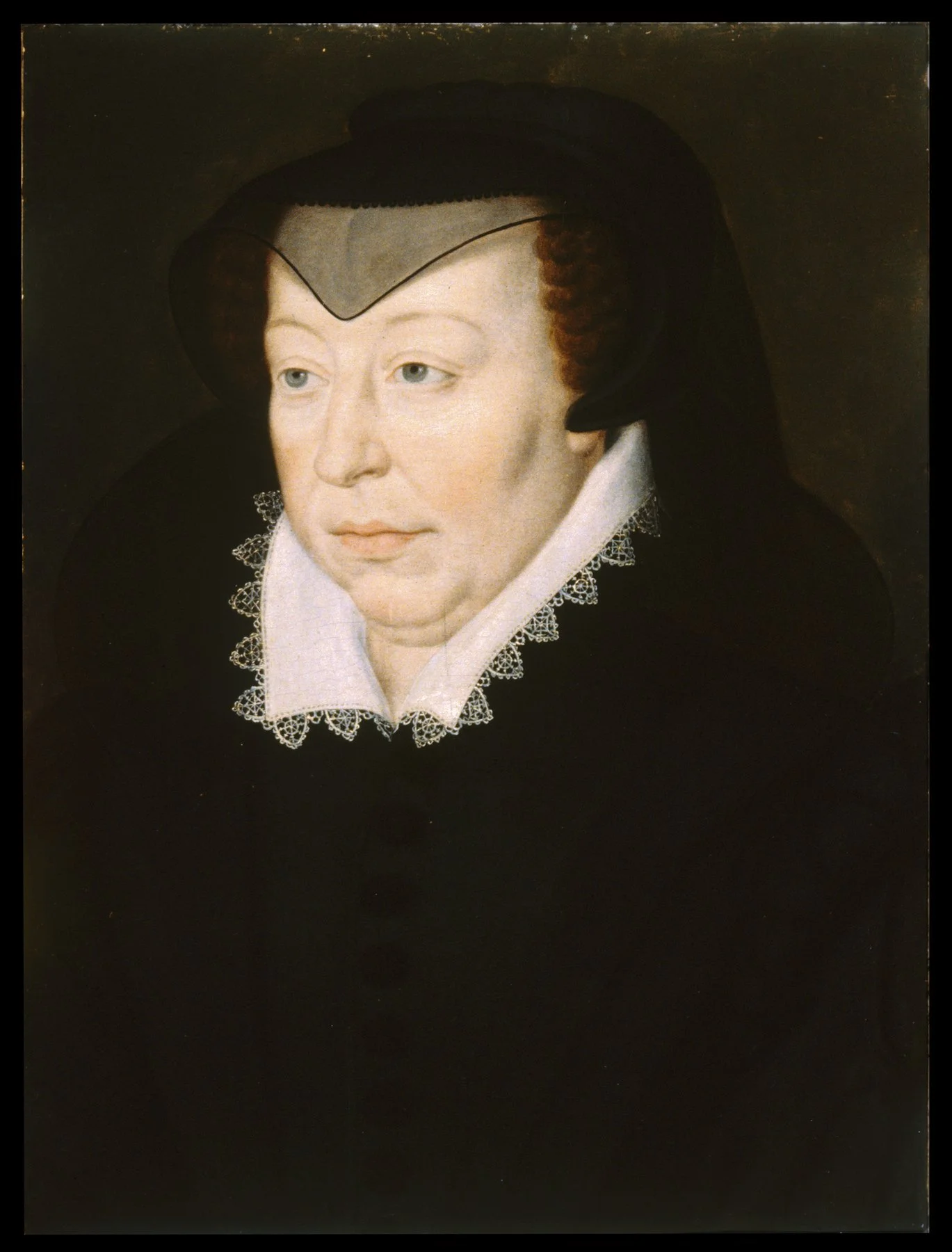
Portrait of Catherine de' Medici, c. 1580, copy after François Clouet, The Walters Art Museum, Baltimore
Catherine de Medici, an Italian noblewoman from a powerful banking family, married King Henry II of France and has gone down in history as the so-called “foodie queen.”
She reigned as Queen of France from 1547 to 1559 and then as Queen Mother from 1559 to 1589, giving her nearly forty years of influence over French politics — and French cuisine.
Cook’s Info notes that Catherine is credited with introducing an astonishing array of foods and culinary practices to France. She is said to have encouraged the use of the fork and to have brought with her artichokes, aspics, baby peas, broccoli, cakes, candied vegetables, cream puffs, custards, ices, lettuce, milk-fed veal, melon seeds, parsley, pasta, puff pastry, quenelles, scallopine, sherbet, spinach, sweetbreads, truffles, and zabaglione.
Among this long list of supposed innovations, she also helped elevate the humble macaron into a courtly delight.
Yet, much like the myths surrounding Marie Antoinette, modern food historians have largely debunked the idea that Catherine single-handedly transformed French cuisine or table manners.
Still, the macaron story persists, in part because Catherine was known to enjoy — perhaps over-enjoy — one particular sweet: a cookie made from almond paste.
This early version of the macaron differed significantly from today’s Parisian classic. It relied on almond paste rather than almond flour and lacked the creamy ganache filling that defines the modern treat. In truth, it was little more than a simple biscuit with a crisp exterior and tender interior, likely brought with her from Italy during the Renaissance.
A couple of centuries later, this would still have been the only macaron Marie Antoinette ever encountered.

Traditional Italian almond cookie. Image credit: Merinka via iStockphoto.com
The French word macaron may derive from the Italian verb ammaccare, meaning “to crush” or “to dent” — a reference to grinding almonds — or from maccheroni, a term that once described any food made from something ground, whether nuts or wheat.
This simple almond cookie had been produced in Venetian monasteries as early as the eighth century and was nicknamed “priest’s bellybutton” because of its round, domed shape. By the eighteenth century, versions flavored with bitter almonds or amaretto became known as amaretti, distinguishing them from maccheroni, which today refers only to pasta.
But the macaron’s story reaches even further back, to the Arab empire of the 600s and 700s, a region that exported almonds and developed almond-based sweets such as fālūdhaj and lausinaj — candies made from almond paste wrapped in dough. When the empire expanded into Europe, the culinary traditions of pasta and almond pastries began to blend, especially in Sicily:
“The pasta and the almond-pastry traditions merged in Sicily, resulting in foods with characteristics of both [Arabic and Italian culinary traditions]. Early pastas were often sweet, and could be fried or baked as well as boiled. Many recipes from this period exist in both a savory cheese version and a sweet almond-paste version that was suitable for Lent, when neither meat nor cheese could be eaten.”
So intertwined were these gastronomic cultures that it’s still unclear whether the word maccheroni originated in Arabic or in the Italian dialect.
What is clear is that almond sweets spread steadily across Europe — first to France with Catherine de Medici, then to Spain and England. By the mid-1500s, the macaron appears in the writings of Rabelais, and shortly afterward it surfaces in English sources (then spelled with two o’s). It even makes its way into Martha Washington’s Booke of Cookery, a handwritten family cookbook she brought from the Old World to the New. The recipe likely dates to the 1600s and is strikingly close to the Italian version.
SISTER ACT.

Traditional French macaron. Image Credit: Julian Elliott via Alamy Stock Photo
In France, several cities proudly lay claim to the macaron and offer their own variations on the historic recipe — among them Nancy, Boulay, Saint-Jean-de-Luz, Saint-Émilion, Amiens, Montmorillon, Le Dorat, Sault, Chartres, Commercy, Joyeuse, and Sainte-Croix.
All of these regional interpretations stem from the earlier, simpler biscuit-like cookie and share far more with one another — and with the Italian original — than with the newer, colorful, perfectly symmetrical Parisian macaron that has become a global icon.
One of the most storied French versions comes from the city of Nancy in northeastern France. According to local legend, two Benedictine sisters, Marguerite Gaillot and Marie-Elisabeth Morlot, sought asylum there during the French Revolution (1789–1799) and supported themselves by baking and selling macarons. Their recipe became so beloved that the “Macarons des Sœurs” remain a specialty of Nancy to this day.
As a historical anchor to the period, Marie Antoinette was executed on October 14, 1793 — placing the sisters’ macarons squarely within the tumultuous years that reshaped France.
The nuns became known as the “Macaron Sisters” (Les Soeurs Macarons), and in 1952 the city of Nancy honored the two nuns by naming the spot where they produced the macarons after them.
You can visit Maison de Soeurs Macarons in Nancy where the cookies are still made to the original recipe (egg whites, sugar, Provençal almonds), although the nuances of the ingredients and technique are still a well-guarded secret, bien sûr.
PLOT TWIST.

Coconut macaroon. Image credit: Boyrcr420 via iStock Photo
In 1871, just fifty years before Laudrée gave Catherine de Medici’s almond cookie a facelift, Esther Levy published the first Jewish cookbook. In it, as a resident of Florida, she featured a recipe for macaroons — spelled with two o’s — using grated coconut instead of the traditional almond flour or paste.
Because the dietary restrictions of the Jewish holiday Passover prohibit the consumption of leavened baked goods, coconut macaroons were an instant success and gained enormous momentum in the food boom following WWI and WWII.
Happily, someone decided to dip them in chocolate at one point.
Meanwhile, Franklin Baker, a Philadelphia flour miller, was the first to discover that shipping shredded coconut was much more affordable and shelf-stable than shipping whole coconuts.
Kosher companies soon caught on and began mass-producing the coconut macaron.
“American Jews suddenly found it easier than ever to observe the holidays with ready-made and shelf-stable foods–the same Streit’s and Manischewitz tins and boxes that we recognize today.”
LA FIN.
Today, tourists flock to the Champs-Élysées to visit Ladurée, thanks in part to its cameo on screen and also to its long-standing reputation for shaping the Parisian tea room scene in the late nineteenth century. The salon de thé became the chic meeting place for high society — and, importantly, one of the few public spaces where women could gather freely.
Things aren’t quite as quaint as they once were. In 1993, Ladurée was acquired by the Holder Group (also owners of the bakery chain Paul), which began a luxury rebranding and global expansion — along with the industrial-scale production of the macaron. Oh well. C’est la vie.
Still, the quality and the mythology persist. And whether you prefer a traditional French or Italian macaron, the modern Parisian version, or even a coconut macaroon, there is no shortage of talented bakers or at-home recipes to try. Macarons have long since moved from fad to fixture, and the flavors available today are nothing short of whimsical. Thai curry or matcha macaron, anyone? Figgy almond or chai macaroon?
And the Oscar goes to…?