Why Does Paris Look So Much Like Paris?
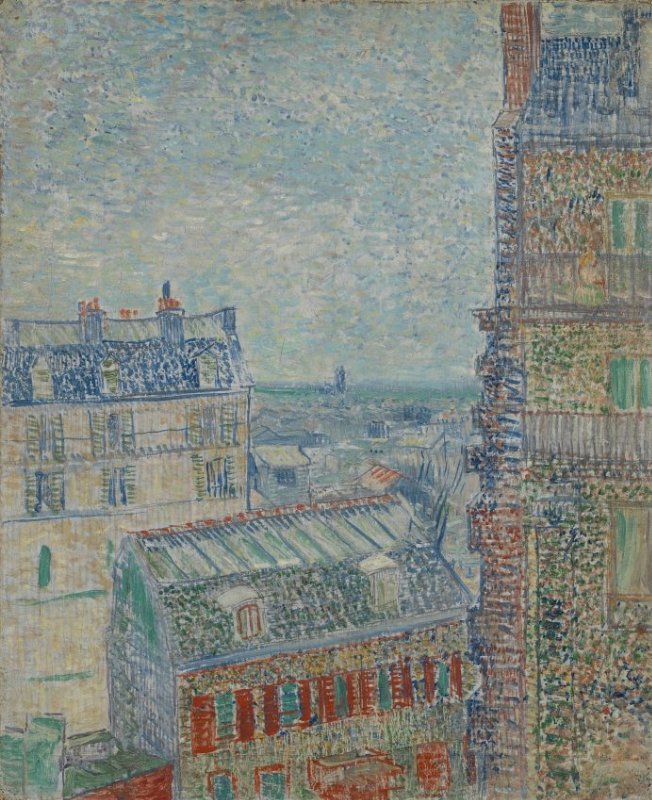
View from Theo's Apartment, 1887, Vincent Van Gogh, Van Gogh Museum, Amsterdam
Paris's broad boulevards, elegant limestone façades, wrought-iron balconies, and gray zinc rooftops are instantly recognizable. Block after block, the buildings seem to follow the same architectural rhythm, giving the city its distinctive sense of harmony.
But Paris hasn't always looked this way. Much of the cityscape we know and love today resulted from an extraordinary nineteenth-century transformation that reshaped not only Paris's streets and buildings, but also the lives of the people who called it home.
Before the Grand Boulevards
In the first half of the nineteenth century, Paris was a very different city. Much of its historic center was a maze of narrow, winding streets, some dating back to the Middle Ages. Buildings crowded together, often rising several stories above streets so narrow that sunlight struggled to reach the ground. Shops and workshops occupied the ground floors, horse-drawn carts competed for space, and pedestrians navigated a bustling, congested city.
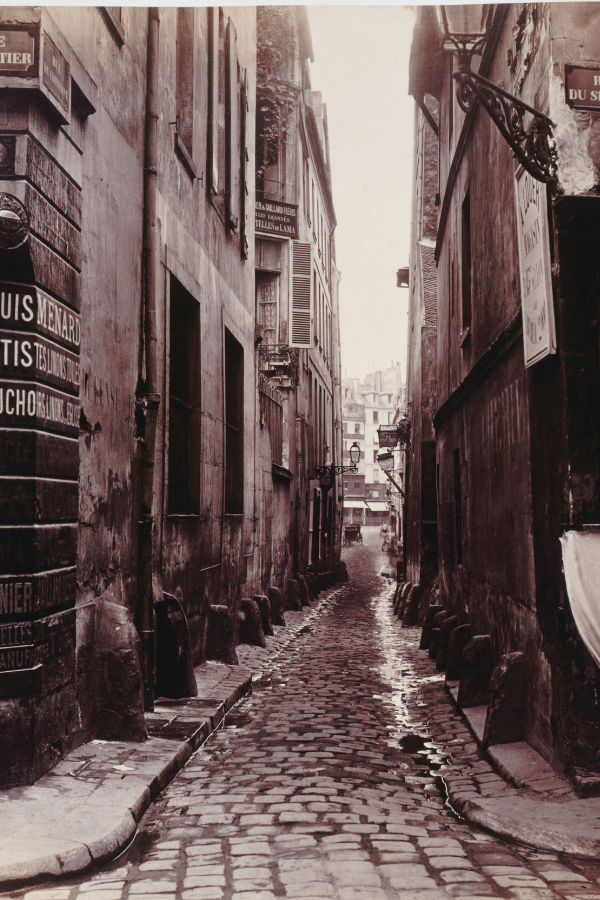
Rue Traversine (from the Rue d'Arras), c. 1868, Charles Marville, The Metropolitan Museum of Art, New York
Paris was also growing rapidly. Between 1801 and 1851, its population nearly doubled, putting enormous pressure on housing and infrastructure that had changed little in generations. Overcrowding and poor sanitation made disease a constant threat, and a devastating cholera epidemic in 1832 killed approximately 18,000 Parisians. The city's narrow streets also made it increasingly difficult to move people and goods through the expanding capital.
Yet old Paris was much more than its crowded streets and unsanitary conditions. Its neighborhoods were home to generations of families, artisans, merchants, and shopkeepers. Markets, churches, and small businesses were woven into daily life, while its irregular streets reflected centuries of the city's history.
By the mid-nineteenth century, Paris clearly needed modernization. But the changes that followed would go far beyond improving sanitation and easing congestion. Much of the old city would disappear, replaced by an entirely new vision of what a modern capital should look like.

La Bièvre, a lost tributary of the Seine, photographed circa 1862 by Charles Marville. As Paris's official photographer, Marville was commissioned to create a visual record of Paris as it underwent Baron Haussmann's grand modernization. Though it lacked the Seine's grand commercial scale, this small river was essential to the city's early industrial identity, powering hundreds of working-class mills, dye shops, and laundries. The surrounding neighborhood was filled with factories that dumped copious amounts of chemical waste into the river. Concerned with the health hazards and “terrible stench,” city officials were already planning to tackle the problem when Marville captured this view. In the image, men at a tannery pause from scraping hides to regard the camera. The tanning profession had deep roots here, but like Old Paris itself, it was on the verge of extinction. Deemed a toxic public health hazard, the waterway was systematically covered over by 1912 and now runs underground through the sewers. Image: “La Bièvre,” c. 1862, Charles Marville, Musée Carnavalet, Paris.
An Emperor's Vision, a Prefect's Plan
In 1852, Louis-Napoleon Bonaparte, Napoleon I's nephew, became Emperor Napoleon III. He had ambitious plans for Paris. After several years in exile in London, he saw firsthand the advantages of a modernizing city, with its parks, broad thoroughfares, and improving infrastructure. He envisioned a French capital that would be healthier, more efficient, and worthy of its place among Europe's great cities.
To carry out this vision, Napoleon III appointed Georges-Eugène Haussmann as Prefect of the Seine in 1853. Haussmann was a determined and formidable administrator who would oversee one of the most ambitious urban redevelopment projects in European history.
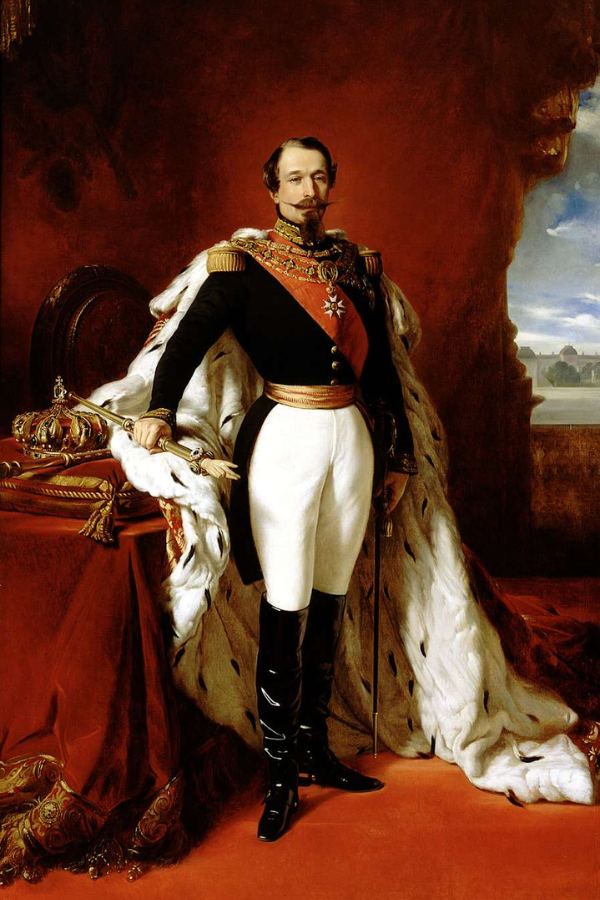
Portrait of Napoleon III, circa 1853, Franz Xaver Winterhalter, Napoleonic Museum, Rome
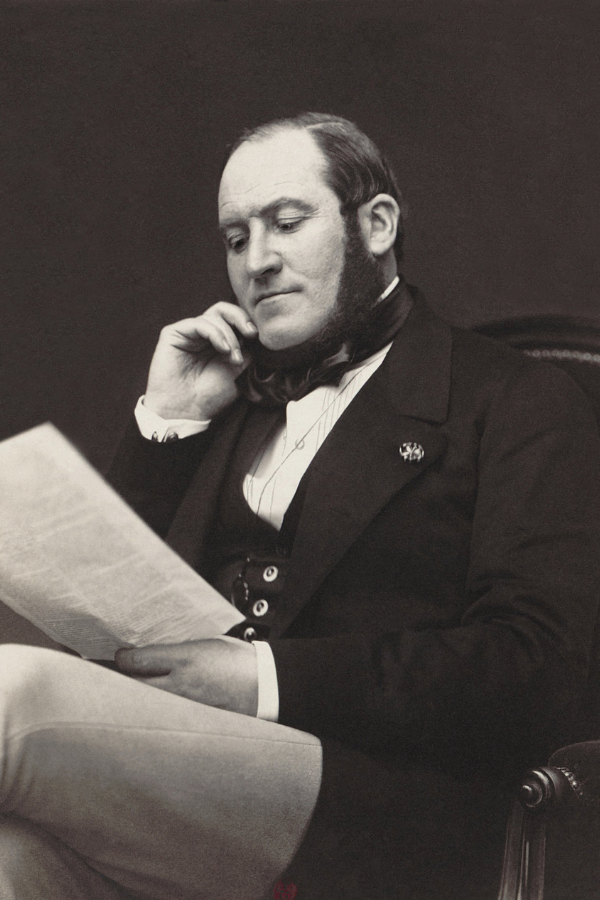
Baron Georges-Eugène Haussmann (1809-1891), Prefect of Paris, urbanist of Napoleon III's Paris, BNF Gallica
Over the next seventeen years, Paris became an enormous construction site. Wide, straight boulevards cut through the existing tangle of streets, creating new connections between railway stations, commercial districts, and important public buildings. Parks and gardens gave Parisians places to escape the crowded city, while an expanded sewer network and modernized water supply addressed longstanding sanitation problems. New street lighting helped transform the experience of Paris after dark.
Consider the Avenue de l'Opéra, today one of Paris's grandest thoroughfares, stretching from the Palais Garnier toward the Louvre Museum. Creating this broad avenue required demolishing entire blocks of buildings and even leveling a small hill known as the Butte des Moulins. Streets disappeared, homes and businesses were torn down, and the familiar neighborhood landscape was erased to make way for the new Paris.
The changes were dramatic, but they came at a considerable human cost. Entire blocks were demolished to make way for the new avenues, displacing residents and businesses and disrupting neighborhoods that had developed over generations.
And while Haussmann is most closely associated with the city's grand boulevards, his influence extended beyond the layout of its streets. The buildings lining those new avenues would give Paris an architectural identity that remains remarkably recognizable more than 150 years later.

Demolition of the Butte des Moulins for the Avenue de l'Opéra, between 12–1876 et 2–1877, Charles Marville, Musée Histoire de Paris Carnavalet
The Architecture of a Parisian Street
The grand boulevards may have transformed the layout of Paris, but the buildings lining them gave the city much of its distinctive appearance.
Haussmann's Paris was designed with remarkable architectural consistency. Building heights were regulated by street width, while façades followed a common visual language of pale limestone, tall windows, wrought-iron balconies, and zinc-covered mansard roofs. Individual buildings could have their own decorative details, but together they created the harmonious streetscapes that have become synonymous with Paris.
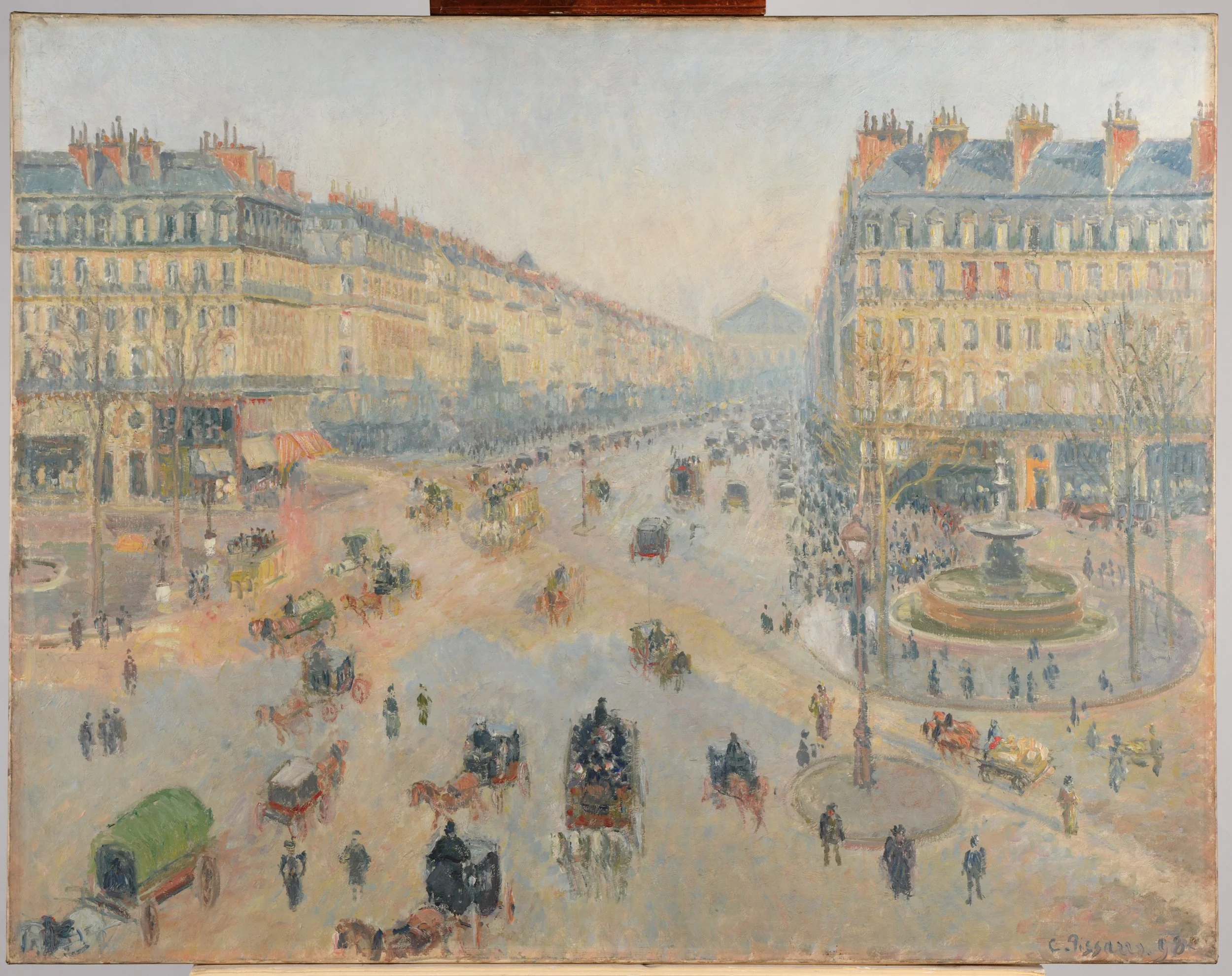
The Avenue de l'Opéra, one of the new boulevards created by Napoleon III and Haussmann. The new buildings on the boulevards had to be the same height and share a basic façade design, all faced with cream-colored stone, giving central Paris its distinctive harmony. L'Avenue de l'Opéra, 1898, Camille Pissarro, Museum of Fine Arts, Reims
Look closely at a typical Haussmannian apartment building, and you'll notice something interesting: the balconies often run continuously across the second and fifth floors. This was no accident.
In the nineteenth century, the second floor was generally the most prestigious address in the building. Known as the étage noble, it offered spacious rooms, high ceilings, and elaborate interiors without requiring residents to climb too many flights of stairs. Elevators were not yet commonplace, so the higher one climbed, the less desirable—and often less expensive—the apartments became.
The fifth-floor balcony, however, served a different purpose. Its continuous iron railing helped establish a pleasing visual symmetry across the façade, echoing the balcony below. Above it, tucked beneath the sloping roof, were smaller rooms frequently occupied by domestic servants.
In this way, the architecture reflected the social hierarchy of nineteenth-century Paris. The most privileged residents occupied the grand apartments below, while those with fewer means lived higher up, often within the same building. Even today, the arrangement of the windows and balconies offers clues to the lives once lived behind them.
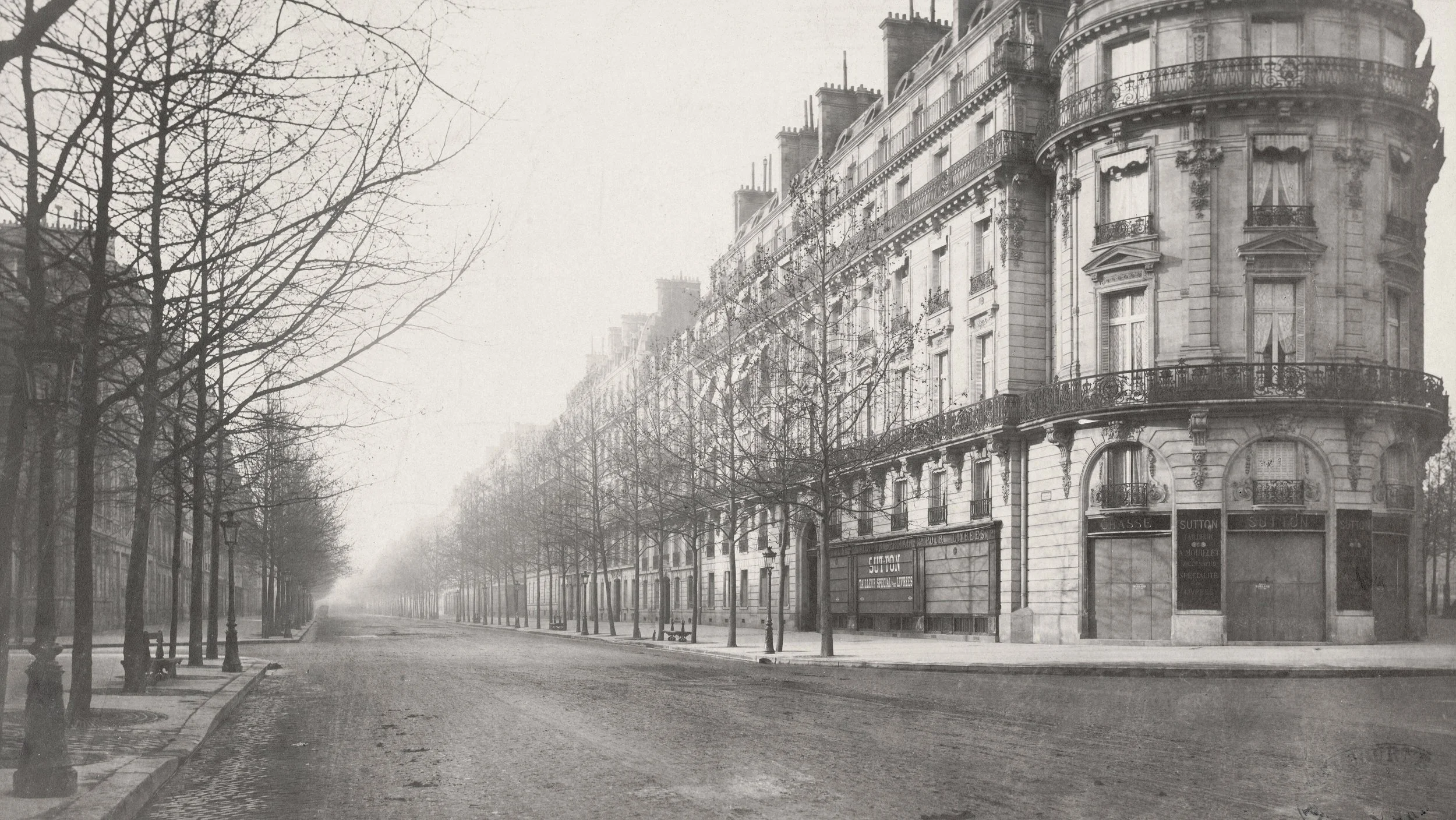
Boulevard Haussmann, de la rue Miromesnil, c. 1853–70, Charles Marville, Bibliothèque d'État du Victoria, Melbourne, Australia
Anatomy of a Parisian Boulevard
The buildings may be the most recognizable feature of Haussmann's Paris, but the transformation extended well beyond their elegant façades. The streets themselves were carefully reconsidered, down to the trees, benches, and lamps that lined the new boulevards.
The new boulevards were designed to be more than routes from one place to another. Wide sidewalks gave pedestrians room to stroll. Rows of trees provided shade and softened the expanses of stone. Benches invited people to pause, while cafés and shopfronts opened onto a more spacious, legible city.
Streetlamps were part of this transformation too. Nineteenth-century Paris was increasingly lit by gaslight, which helped make the city safer, livelier, and more usable after dark. The effect was practical, of course, but also theatrical. A boulevard lit by rows of elegant lamps became a place to see and be seen.
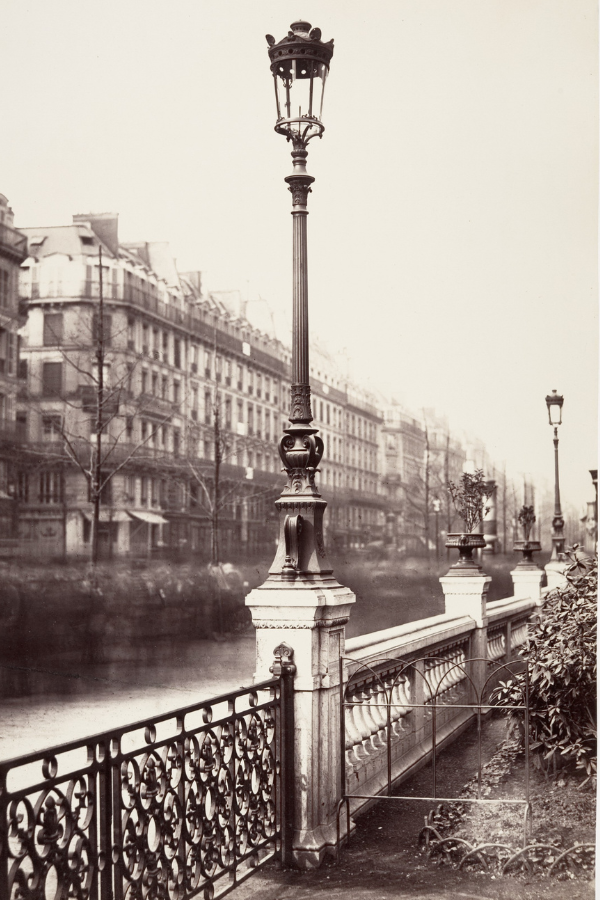
In the mid-nineteenth century, Paris was a dark and dangerous labyrinth after sunset. This changed under Baron Haussmann's radical urban renewal. By 1870, twenty thousand gas lamps lit the city streets, replacing hand-held lanterns and armed guards with a public glow that earned Paris its enduring moniker: the City of Light. Arts et Métiers (Ancien Modèle), 1864, Charles Marville, The Metropolitan Museum of Art, New York
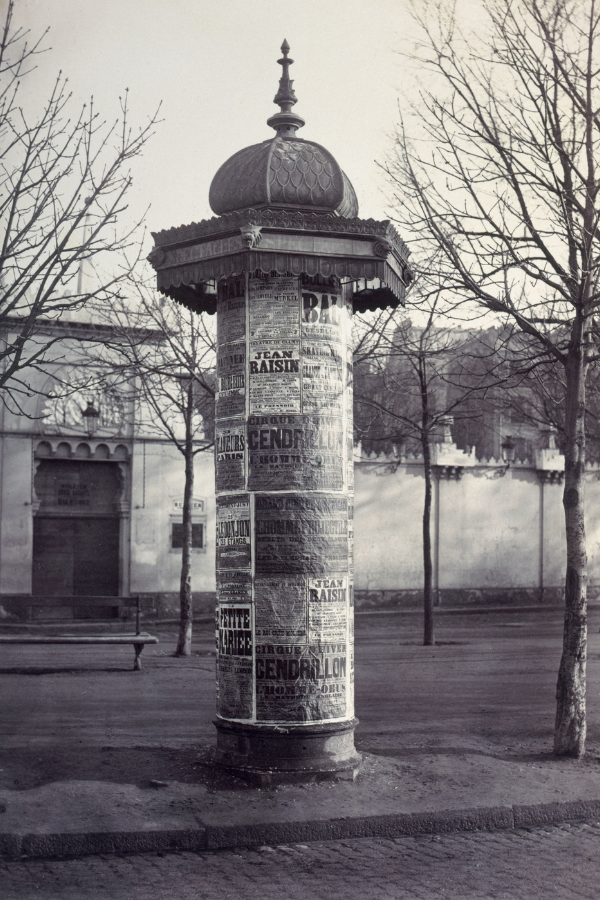
One of the emblems of Haussmann’s Paris, cylindrical kiosks were part of a broader impetus to define and control the proliferation of printed advertising that had transformed the city, in the words of one writer, into “an immense wall of posters scattered from the chimneys down to the sidewalks with clusters of squares of paper of all colors and formats.” Image: Charles Marville, January 1876, Musée d’Histoire de Paris Carnavalet

Sometimes called vespasiennes (after the first-century Roman emperor Vespasian, who generated revenue through the public latrine system), Paris installed its first public urinals in 1834. Their numbers multiplied greatly during the Second Empire, owing to Haussmann’s near obsession with sanitation. Varying from basic shells to ornately decorated structures, the vespasiennes (only one remains) often featured advertising columns and were sometimes topped with a lamp. Urinoir à 3 Stalles (Chaussée du Maine) (Urinal with Three Stalls, Chaussée du Maine), 1875–1876, Charles Marville, Musée d’Histoire de Paris Carnavalet
Even the street furniture contributed to the new visual order. Under Napoleon III, architect Gabriel Davioud helped shape many of the details that still feel quintessentially Parisian today, from benches and lampposts to kiosks, railings, and the distinctive Morris columns used for posters and advertisements. These features gave the city a sense of consistency that extended well beyond its buildings.
And beneath the surface, another transformation was underway. Improved water systems and an expanded sewer network addressed longstanding sanitation problems that had plagued the old city. Paris was being remade not only for beauty, but for circulation, comfort, and modern urban life.
Taken together, these changes created one of Paris's defining experiences: the boulevard as a place to walk, observe, linger, and participate in the life of the city.
The Other Side of Haussmann's Paris
The transformation of Paris brought undeniable improvements. New boulevards made the city easier to navigate, expanded water and sewer systems improved sanitation, and parks and gardens provided much-needed green space. The elegant apartment buildings and grand avenues also established an architectural identity that would influence urban planning far beyond France.
But not everyone benefited equally from the new Paris.
The thousands of residents displaced by demolition did not necessarily find a place in the neighborhoods that replaced their old ones. New apartments were often priced beyond the means of working-class families, while rising property values and rents made many central districts increasingly expensive. Those who could no longer afford to remain often moved toward less costly neighborhoods in eastern Paris or beyond the city's boundaries.
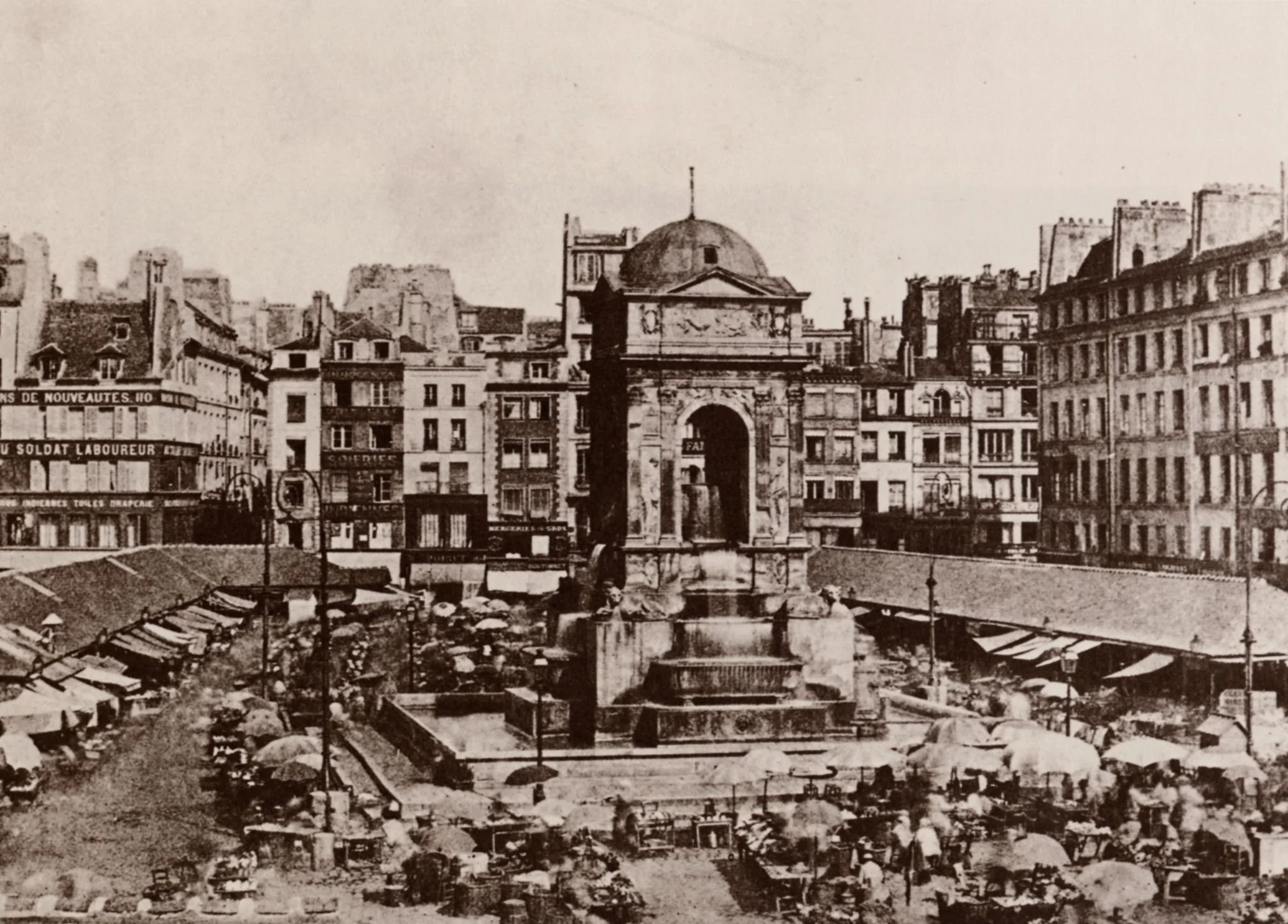
Sometimes called the Marché des Innocents (named after the Holy Innocents' Cemetery that occupied the site for over six centuries), this historic open-air market was opened in 1788 after a severe public health crisis forced the exhumation of over two million bodies to the Paris Catacombs. The bustling square served as a central right-bank marketplace for herbs, flowers, and vegetables until the 1850s, when Emperor Napoleon III and Baron Haussmann launched their sweeping modernization of Paris. Driven by Haussmann's near-obsession with sanitation and grand design, the market and its surrounding medieval neighborhood were aggressively demolished, displacing thousands of working-class residents to make way for the massive glass-and-iron pavilions of Les Halles. Marché des Innocents (Market of the Innocents), ca. 1855, Charles Marville, Musée d’Histoire de Paris Carnavalet.
These changes contributed to a growing geographical division between wealthier western neighborhoods and the more working-class districts of eastern Paris. That division predated Haussmann, but the redevelopment helped reinforce it.
Beyond the economic consequences, something less tangible was also lost. The winding streets and densely populated neighborhoods of old Paris had supported generations of shopkeepers, artisans, and families. Demolition meant not only the disappearance of buildings, but the disruption of communities and the everyday relationships that gave those neighborhoods their character.
There is a certain irony in all this. The Paris we admire today for its historic beauty and architectural harmony was itself created through the destruction of much of an older city. The same boulevards that brought light, space, and modern infrastructure also swept away streets and communities that had been part of Paris for centuries.
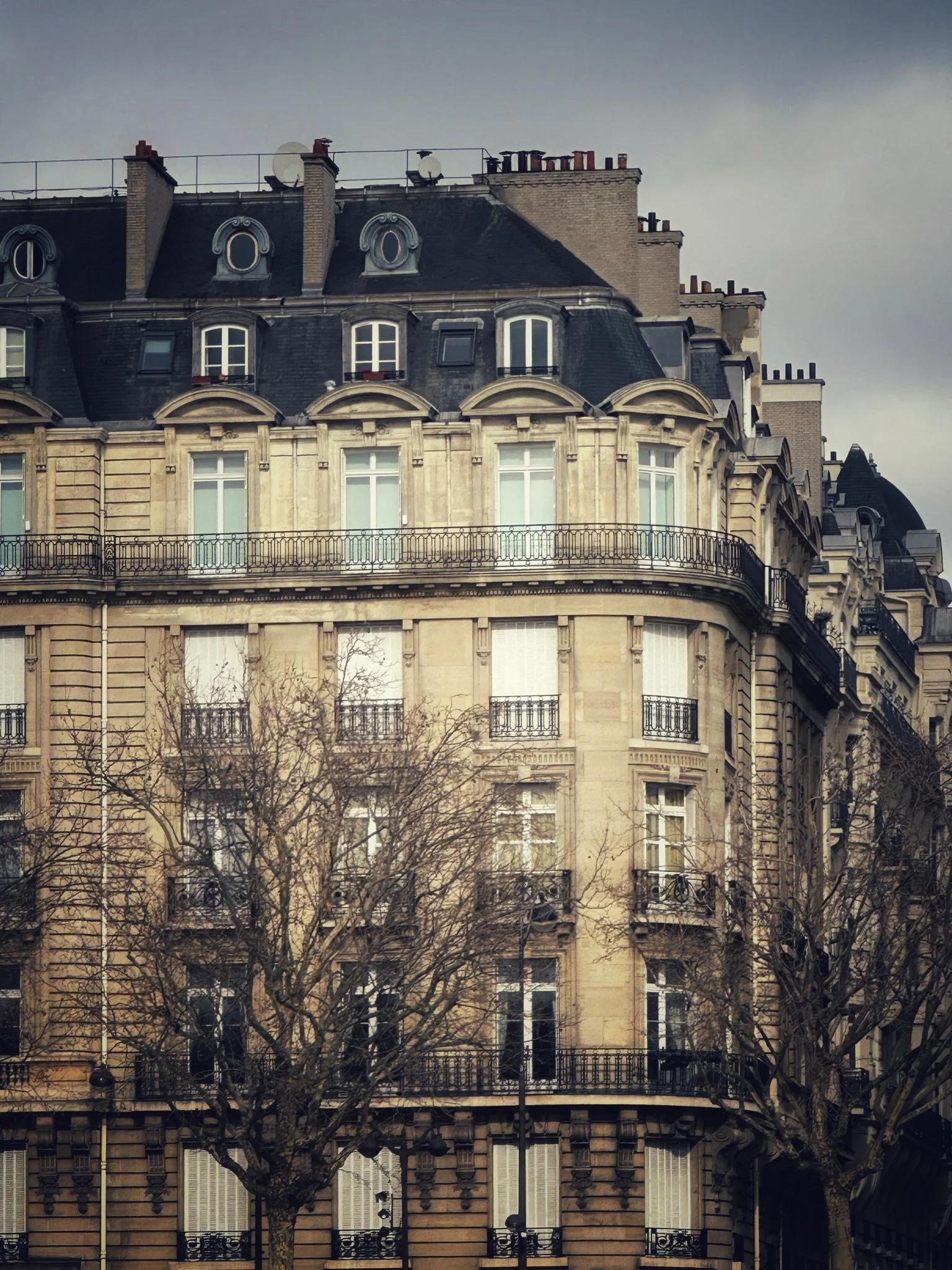
Image by author.
The next time you're walking through Paris, take a moment to look up. Notice how the balconies line up across neighboring buildings, how the windows grow smaller toward the roofline, and how the pale limestone façades create a sense of harmony along an entire street.
These details are more than architectural flourishes. They tell the story of a nineteenth-century vision that transformed Paris, bringing modern infrastructure, elegant boulevards, and a new way of urban living, while also displacing communities and sweeping away much of the older city.
Paris may appear timeless, but much of what makes it so recognizable today resulted from deliberate choices made little more than 150 years ago. Once you know the history, even an ordinary Parisian street becomes something worth lingering over.